
Enterprise marketing is going through something bigger than just “AI adoption.” What’s actually changing is the way content itself moves inside organizations. Instead of campaigns being planned, produced, and launched in cycles, content is starting to behave more like a continuous system – always being generated, adjusted, reused, and redistributed. That’s where the idea of an AI content supply chain — supported by systems like AI-BOM (AI Bill of Materials) for marketing assets — really comes in.
It’s less about tools and more about structure. And in a lot of companies, that structure is still being figured out in real time.
The shift from campaigns to systems
For a long time, marketing worked in pretty predictable cycles. You planned a campaign, created assets, launched them, measured results, and then started over. That rhythm is breaking.
With AI content supply chains, content doesn’t really “finish” anymore. It keeps moving. It gets remixed, re-versioned, localized, and reactivated depending on where it’s needed. Adobe has already started building around this idea of connected content systems that link creation and distribution across channels.
The interesting part is not automation itself; it’s that content is becoming something closer to infrastructure than output.
Enterprise Content Automation is quietly changing roles
Most companies don’t talk about this openly yet, but enterprise content automation is already reshaping who does what inside marketing teams.
A lot of the repetitive work — resizing assets, generating variations, localizing messaging, even writing first drafts — is slowly being absorbed by AI systems. What’s left for humans is less about execution and more about deciding direction, reviewing output, and managing systems.
It sounds efficient on paper, but in practice it also changes how teams are structured. Some roles shrink, some expand, and some quietly disappear into automated workflows.
Agentic Content Orchestration is where things get more interesting
This is where it starts to feel less like “tools helping humans” and more like systems doing work on their own.
With agentic content orchestration, AI doesn’t just respond to prompts; it reacts to signals. A product update happens, and content gets generated. A campaign underperforms, and variations get created. Assets get routed, approved, and distributed with less manual coordination.
We’re still early here, but marketing workflows are slowly becoming self-operating systems, where humans define rules more than they execute tasks. You can already see early movement in enterprise AI discussions around agent-based execution layers.
Content Provenance is becoming unavoidable
The more AI generates, the harder it becomes to answer a simple question: where did this content actually come from?
That’s where content provenance is starting to matter. It’s basically about tracing how content was created: what data influenced it, which models were involved, and how it changed along the way.
Without that visibility, enterprises risk losing control over compliance, brand safety, and even basic accountability. This is beyond a marketing issue, something researchers have been warning about in broader AI systems for a while.
Modular Content Libraries are doing the heavy lifting
One of the less flashy but very important changes is the rise of modular content libraries.
Instead of treating content as finished pieces, companies are breaking it into reusable parts: headlines, product descriptions, visuals, tone elements. These pieces can then be recombined depending on context.
This is actually what makes personalization at scale possible. Without modularity, AI-generated content would just create more chaos, not more efficiency.
AI-BOM is forcing transparency into content creation
As content gets more complex, companies are starting to adopt something called an AI-BOM.
Think of it as a breakdown of everything that went into a piece of content: data sources, prompts, models used, creative inputs, and compliance checks. It sounds technical, but the goal is simple: make content creation traceable.
This becomes important when multiple AI systems are involved in producing a single asset, which is becoming more common than people realize.
Semantic Tagging is what makes the whole system usable
At the base of all this is semantic asset tagging. Without it, none of the above really works at scale.
Instead of manually labeling content, AI now assigns meaning automatically: what the content is about, who it’s for, what tone it carries, and where it should be used.
This is what allows systems to actually “understand” content instead of just storing it. And once that layer exists, everything above it — orchestration, automation, reuse — becomes possible.
Final Thought
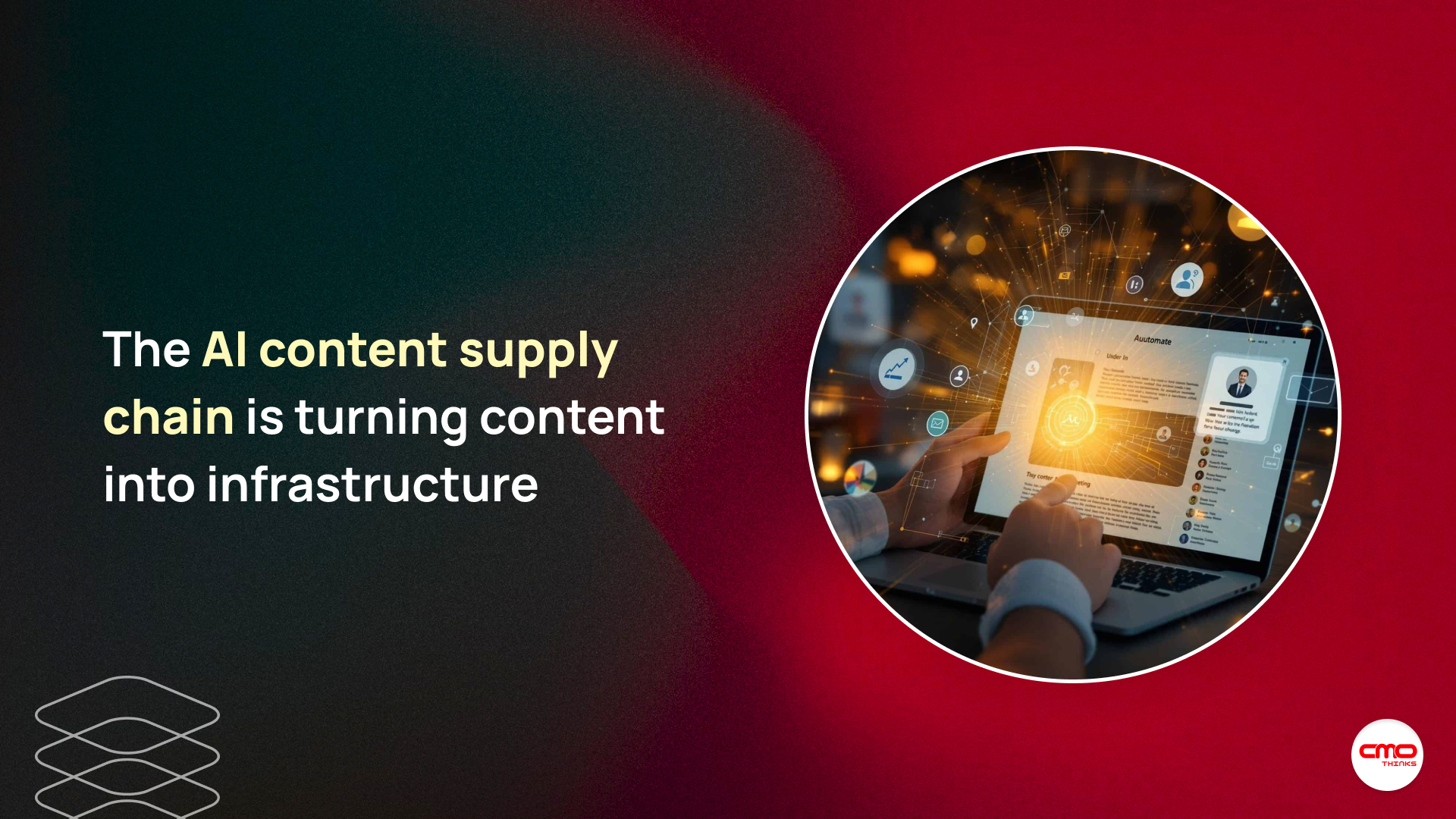
The AI content supply chain is turning content into something closer to infrastructure; something that is continuously produced, governed, and reused inside a system rather than created as standalone output.
And maybe the biggest change is this: marketing is slowly moving away from being a creative production function and becoming a managed, AI-driven system of content operations.
Not cleaner. Not simpler. Just… more continuous.