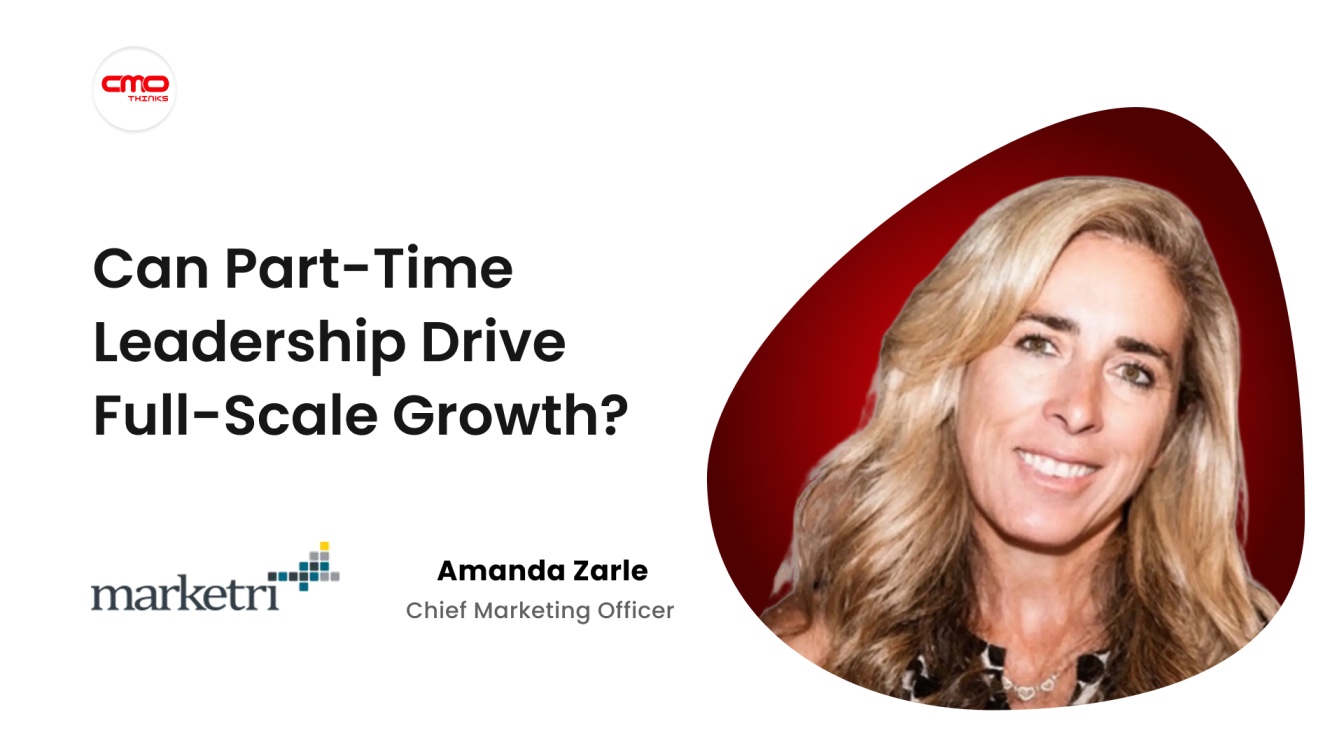
You’ve built a career leading marketing across healthcare, financial services, and tech — what’s one challenge that consistently cuts across industries?
Across healthcare, financial services, and tech, the hardest challenge is keeping teams aligned in a world where buying has become overwhelmingly self-directed and fragmented across channels. Customers expect brands to meet them everywhere, and more than 80% now use multiple channels to research or purchase. According to a McKinsey study, B2B buyers have expanded from five points of interaction in 2016 to about ten today, and in my own work, I have seen that number climb much higher. In SaaS alone, the touchpoints required to close a deal have risen into the hundreds. A 2024 HockeyStack analysis shows it now takes more than 70 interactions to generate an MQL and more than 260 to close a deal.
This complexity shows up clearly in my client work. Some buyers take 18 months of steady engagement across channels before they are ready to decide, while others close in one month after a small number of meaningful moments. That range creates enormous pressure on companies to show up consistently and credibly in every interaction. Designing that presence with clarity is the real test, especially as research shows many buyers prefer to avoid sales until the very end. The challenge is not the industry. It is the widening gap between how customers buy and how most organizations are structured to meet them.
When building ROI-driven strategies for mid-sized companies, what core priorities guide your approach?
I always start by grounding the marketing plan in the company’s business model because every ROI conversation falls apart when the business itself is not clearly defined. Mid-sized companies see the strongest returns when their ideal customer profiles, buying motions, and pipeline metrics are aligned and measured with discipline. From there, the right balance of demand creation and brand building keeps the company visible in a crowded market while still driving near-term revenue. I have watched companies push everything into bottom-of-funnel tactics only to realize they were invisible to the buyers they needed most. A strong narrative and a system that tracks what matters will outperform a long list of disconnected tactics every time.
As a fractional CMO, how does your role overlap with and differ from a full-time CMO?
The strategic work is the same. As a fractional CMO, I partner with CEOs, shape the growth agenda, build the narrative, and align sales and marketing around the customer. The difference is the structure. Companies gain senior judgment and an experienced team without carrying the cost of a full-time department, which has become even more important as marketing budgets tighten. Our teams have a general manager mindset, and while we may not own the whole P&L, we understand what drives the business. When marketing leaders are embedded in strategic decision-making and take responsibility for a customer-centric growth strategy, companies perform better. Recent McKinsey research shows companies grow significantly faster when a customer-centered leader has real influence at the executive level. Fractional teams allow mid-sized companies to access that level of leadership with more flexibility and speed.
If a marketing framework isn’t delivering results, how do you diagnose the problem and decide what to change?
I start by validating whether the framework is aimed at the right problem. Many underperforming programs come down to unclear ICPs, misaligned KPIs, or motions that do not reflect how customers actually buy. There is no single playbook for B2B companies. I have had clients where every paid channel underperformed, yet tradeshows consistently delivered because that was the moment buyers wanted to experience the product and build trust. Others saw their cleanest lead flow through content, AIO, and PR. Giving each approach enough runway to generate a real signal reveals what the market responds to. The goal is to adjust with intention rather than chase noise.
With the explosion of AI-powered marketing tools, how do you assess which ones align best with a client’s offerings and marketing maturity?
Many clients start experimenting with AI-powered tools only to see modest gains. I always prefer to start with the problem the company needs to solve and map the right tools against those problems. AI delivers real value only when it matches a clear use case and can be supported by the team’s systems, skills, and intent. Recent studies show meaningful lifts in personalization and predictive accuracy when AI is tied to specific outcomes, but those gains only materialize with a strong data foundation. A typical example is a leadership team asking for AI marketing, only to discover their biggest bottleneck is a weekly reporting process that consumes forty hours. Automating that work frees capacity and improves visibility, which often creates the conditions for more advanced AI to succeed. Once the fundamentals are solid, AI becomes a multiplier rather than a distraction.
In your experience, what positive changes has AI brought to marketing teams beyond automating workflows?
AI has raised the strategic ceiling for marketing teams. I see stronger forecasting, sharper targeting, and richer customer insights because predictive models surface patterns that used to take days of focus groups, research, and manual work to uncover. While there are meaningful performance gains when teams apply AI with intention and judgment, I encourage teams to stay grounded in their own analytical skills. I learned to find patterns by digging through spreadsheets myself, and that experience builds instincts that cannot be outsourced. AI is at its best when it accelerates thinking, not when it replaces it.
Finally, how do you envision the fractional marketing model evolving over the next few years?
Fractional marketing is becoming a core growth model for companies that want seasoned leadership without building a full department. I have seen how powerful it is when a mid-market company gains an integrated team across strategy, analytics, creative, PR, and AI at a scale they can sustain. This model democratizes access to senior talent that was once reserved for enterprise budgets and allows companies to compete far above their weight. Analysts expect significant expansion in fractional roles as organizations look for flexibility, specialization, and deeper expertise in data and AI. For many businesses, the fractional model will become the operating norm rather than a temporary solution.