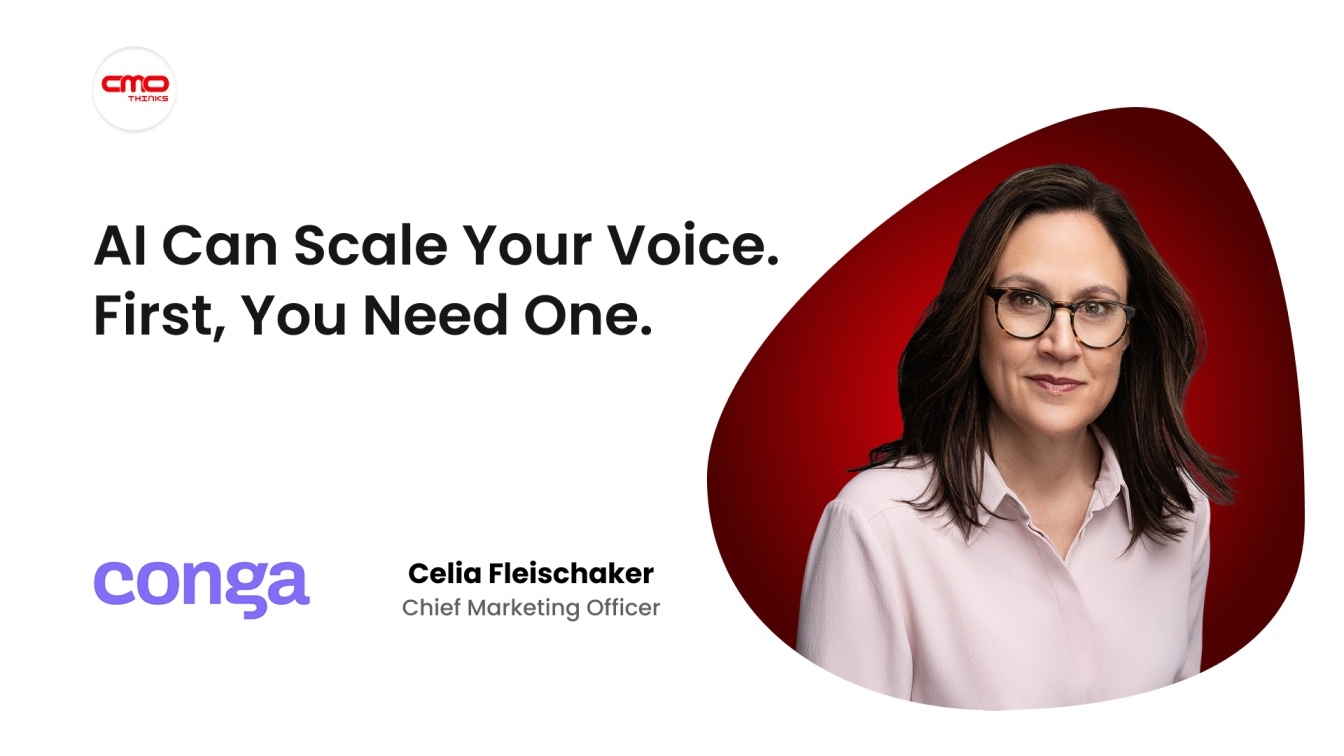
You’ve spent over two decades driving growth across B2B software through GTM strategy, global expansion, and M&A. How have those experiences shaped the way you lead marketing at Conga?
My career in B2B technology has given me the opportunity to see firsthand how companies evolve, from the SaaS transformation to growth through new markets, acquisitions and changing customer expectations. What those experiences reinforced is that the fundamentals don't change—clarity of vision, alignment across teams, and genuine customer understanding matter whether you're entering a new market or integrating an acquisition.
At Conga, I bring that perspective by focusing on both performance and culture. Marketing has to tell more than a compelling story and help the business understand where the market is moving, how the buying journey is evolving, where customers are facing friction and how we can create meaningful differentiation.
Conga unifies CPQ, CLM, and document automation on a single platform. How does this connected approach help businesses move beyond operational efficiency to smarter commercial decision-making?
Commercial operations are fragmented, and companies are realizing that this fragmentation comes with a cost. Conga’s research confirms this, with 93% of decision-makers saying deals routinely stall as they move across sales, pricing, legal, and finance.
When those processes and systems are disconnected, organizations lose visibility, slow down decision-making, and create friction across the customer journey.
The executives we speak with are living this. And it reinforces the long-term vision Conga has always had: connecting the people, processes and systems that improve decision-making, drive revenue, and decrease risk.
As customer expectations evolve, so must market positioning. How are you ensuring Conga's messaging stays relevant while reinforcing its long-term vision and differentiation?
Staying relevant starts with staying close to the customer and that means listening across every layer. Digital relationships are table stakes now. How buyers interact with content, the intent signals they surface, the questions they're searching for answers to—that's a continuous feed of information about where the market is and where it's heading.
But digital signals only tell part of the story. Live interactions, whether that's our regional roadshow series or our customer community, give you something different. When a customer says something in a room, unprompted, it carries a different weight than a click pattern. When you hear the same theme across five conversations at an event, that's a signal worth acting on, not just logging.
Having led marketing through growth and acquisitions, what have you learned about creating a consistent customer experience while integrating products, teams, and brands?
The risk in any acquisition is that the internal disruption, changes to teams, strategy, and roadmap, can travel to the customer before you're ready. Preventing that starts with bringing analysts in before anything is announced to pressure test the story and get an honest read on how the market will receive it. From there it's about building a combined narrative and moving quickly on early wins.
The communication plan starts with employees. If the people now working together do not understand the new narrative, that confusion travels to the customer fast. I have come to treat internal clarity as a customer experience deliverable, not a nice-to-have that follows the real work, but a prerequisite for it. That means plain communication, early and often, about what is changing, what is not, and why.
Speed matters too. At Conga, when we brought in PROS B2B, we rebranded immediately. It was a deliberate signal that we were one company now, not two organizations figuring out how to share a roof. That kind of move changes the internal story as much as the external one. You rarely get a second chance to establish that you're one team.
Enterprise buyers are inundated with AI-driven messaging. How do you build trust and differentiation in a market where every company claims to be transformative?
Enterprise buyers have developed a finely tuned radar for messaging that sounds polished but says nothing. Today that radar is getting a workout because nearly every B2B company has plugged their value proposition into an AI tool and is broadcasting the same transformative future back at the same buyers.
AI has a legitimate role in go-to-market. It can sharpen positioning, personalize outreach at volume, and surface patterns in customer language that human teams might miss. Used well, AI amplifies what's real.
The problem is when it becomes a substitute for the hard, human work of understanding why your solution matters to a specific buyer. When you outsource that thinking entirely, your messaging becomes a composite of everyone else's. The stories that actually build trust come from your customers, your delivery teams, your lost deal reviews. AI can help you scale those insights, but it can't invent them.
You can and should use AI to help you strengthen your messaging, but it should serve a point of view that is genuinely yours. The market is flooded with AI-polished messaging. The scarcest resource right now is a company that clearly knows who it is and why that matters. That still needs to come from you.
If AI makes commercial operations largely autonomous over the next five years, what do you think will become the defining role of marketers and the biggest challenge they'll need to solve?
If AI takes over more of the mechanics, the marketer's job shifts further toward judgment. Which signals actually matter. What a buyer needs before they say it. Internally, teams may use AI-assisted tools to understand audiences and approach prospects, but someone still has to decide what story is worth telling and why it should matter to that customer.
The biggest challenge will be adoption. The technology will keep outpacing organizations' ability to use it well, and the marketers who thrive will be the ones who invest as much in training their teams as they do in the tools themselves. The real risk isn't falling behind on technology but using automation as cover for disengagement. The marketing leaders who matter in five years will be the ones who remain accountable for outcomes even as more of the execution moves to machines.