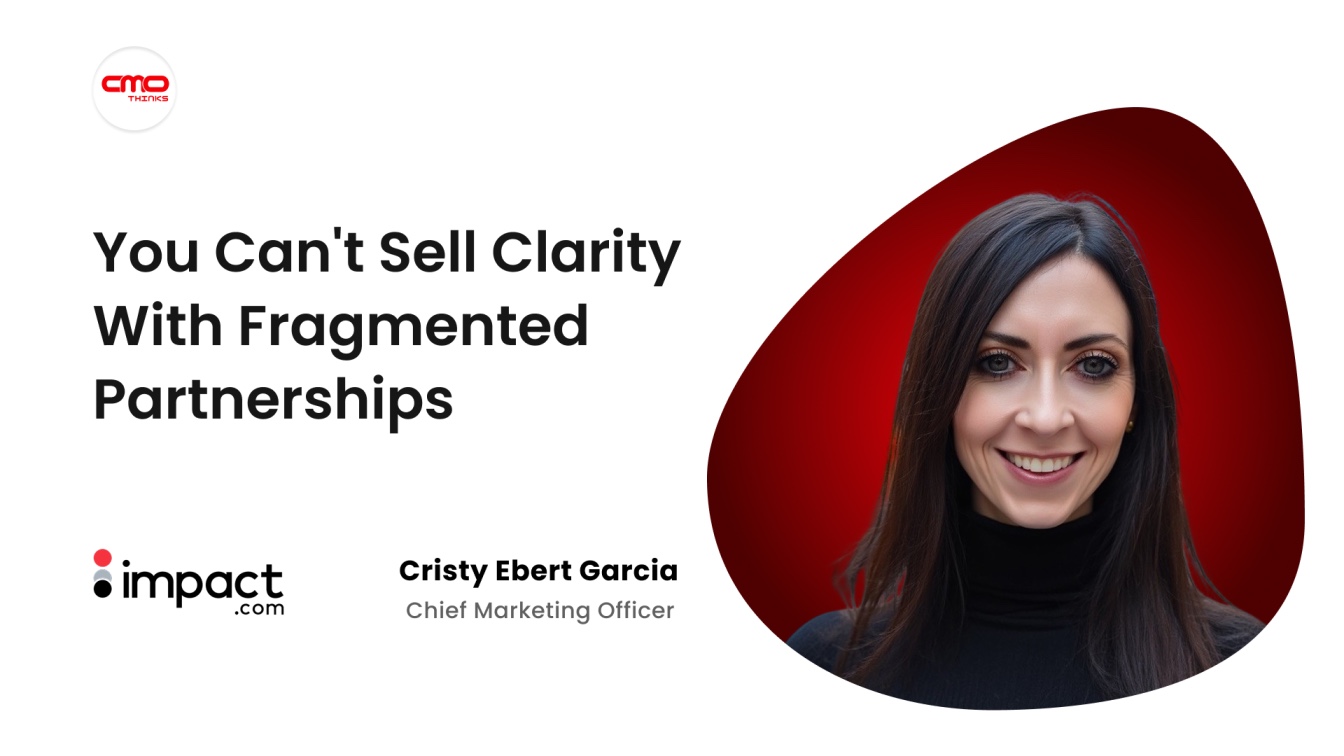
When you joined impact.com, what market truth about partnerships most shaped your marketing strategy from day one?
I joined impact.com in May 2018, and the world – certainly the digital marketing world – was a very different place. That period saw the democratization of commerce content in progress. Audiences were moving away from traditional broadcasters and consuming content on platforms like YouTube and Facebook. Blogs, influencers, and video reviews were beginning to prove their potential as marketing tools, and trust was migrating from brands to influencers.
As the industry was being reshaped, partnerships were already one of the largest revenue drivers for brands, but they were still managed like a side channel. The market didn’t need to be convinced that partnerships worked – it needed a system to run them with accountability, trust, and scale. impact.com’s strategy became about elevating partnerships from tactic to growth infrastructure.
impact.com doesn’t sell a single motion; it enables an ecosystem. What is the hardest thing about marketing many-to-many value without diluting clarity?
Marketing many-to-many actually enhances clarity for brands and advertisers. The impact.com platform anchors a unifying problem – fragmented, opaque partnership operations – rather than leading with every use case.
Clarity comes from outcomes such as growth, trust, and efficiency, not from listing every participant in the ecosystem. And the more brands invest in a partnership ecosystem, growing a roster that features a variety of collaborators, the more information they will have at their disposal to bring clarity to their campaigns.
In particular, various recent impact.com tech advances and innovations have mitigated the thorny issue of attribution. That’s down to the volume of data we have on a campaign, and how we process and analyze it.
What subtle gaps in partnership management is impact.com proactively addressing? How does your marketing communicate the criticality of these mechanisms?
One of the most overlooked gaps in partnership management is fragmentation – across tools, teams, and partner types. Brands often manage affiliates, creators, and advocates in silos, using disconnected systems for discovery, tracking, attribution, and optimization. That fragmentation creates blind spots, where unattributed revenue, misaligned incentives, and compliance issues quietly undermine performance.
impact.com addresses this by acting as the system of record for partnerships. We unify both the technology and the execution, connecting the full partnership lifecycle across creator, advocate, and performance solutions in a single platform. This gives brands a single, reliable view of partnership performance and the confidence to manage all types of partnerships consistently as they scale.
Our marketing focuses on reframing these capabilities as growth infrastructure, not backend plumbing, showing how making the invisible visible and closing small systemic gaps unlocks scalable, durable growth.
Partnership platforms involve multiple stakeholders. How do you approach marketing to actively shorten sales cycles in complex buying groups?
Complexity stalls deals. impact.com simplifies partnership marketing by giving all stakeholders a shared system of record. When a clear narrative is presented through this system of record, each stakeholder, regardless of their role, has a clearer path to success. Everyone reads from the same page, essentially, and when everyone sees their win in the same framework, decisions happen faster.
From a technical perspective, building the impact.com platform to facilitate this level of clarity and speed in often incredibly complex campaigns has taken 18 years. But we’re now at a place where the technology makes the complex simple, and delivers on partnership marketing’s true promise.
You’ve spent a significant part of your career in category creation. How do you know when a category narrative has stuck enough to shift from evangelism to competitive differentiation?
I find that when prospects and competitors start using your language without being prompted, you can be confident you’re on to a winner. When the conversation shifts from “Why does this category exist?” to “Why this platform?” you know a narrative has stuck. At that point, marketing pivots from education to proof, benchmarks, and leadership.
How do you ensure AI augments marketing ingenuity and strategic thinking within your team rather than replacing it?
AI has moved quickly from a technical capability to a cultural conversation, and with that has come a lot of anxiety about what it replaces. At impact.com, we’re very clear: AI is an accelerator, not a substitute for human thinking.
We’ve been using AI and machine learning behind the scenes for years to improve measurement, attribution, optimization, and analysis. Where we draw the line is in decision-making and storytelling. AI helps our teams move faster, test more, and see patterns at scale, but humans still own strategy, judgment, and narrative.
We’re also realistic about AI’s limits. Creative and brand-building are inherently human disciplines, rooted in context, empathy, and trust. Research increasingly shows that consumers can tell when creative lacks that human layer, and they respond poorly when it does. That reinforces our belief that marketing ingenuity can’t be automated.
So our approach is to raise the bar, not lower it. By removing friction from execution and analysis, AI gives our teams more time and headspace to think deeply, ask better questions, and make smarter decisions. In that sense, the easier execution becomes, the more valuable human insight is, and that’s exactly where we want our teams focused.
Where does marketing’s influence on revenue tend to be underestimated by leadership? How do you close that confidence gap at impact.com?
At impact.com, our leadership team has a strong understanding of marketing’s role in driving revenue. More broadly, though, marketing’s influence is often underestimated in areas that don’t show up neatly in a funnel report – things like category clarity, buyer alignment, and trust-building. Those factors have a direct impact on conversion rates, deal velocity, and long-term customer value, even if they’re not always labeled as “revenue-driving.”
We close that confidence gap by making those connections explicit. That means tying marketing’s work to pipeline quality, sales efficiency, and expansion – not just lead volume. When marketing is measured on how well it clarifies the category, equips sales, and builds confidence with buyers, its revenue impact becomes much easier to see and much harder to discount.
How has your background as a generalist shaped how you devise tightly knit strategies, structure teams, and set priorities?
Being a generalist forces you to think in systems, not silos. I optimize for teams that understand the full customer journey, not just their functional lane.
It’s about building a holistic marketing culture – one in which strategy, structure, and prioritization only work when they reinforce each other.
Marketing grows exponentially more interesting – and more challenging – as new channels arrive, audience behavior evolves, and the consumer journey changes in response. There has never been a more fascinating, exciting time to be in marketing, and a generalist approach means strategies, teams, and priorities are embedded in the broader company’s goals.
What legacy do you envision impact.com’s marketing leaving on how partnerships are perceived and valued?
impact.com’s ongoing legacy is that partnerships are not just a marketing channel or a “nice-to-have,” they are a core growth driver and a true competitive differentiator. Over the last few years, the marketing landscape has changed dramatically. Brands no longer solely control how their products and services are discovered. Instead, consumers invite brands into their worlds through the people and communities they trust, whether that’s affiliates, creators, or advocates.
At the heart of effective partnerships today are trust, authenticity, and shared values. Marketing that leans into these principles drives real engagement, builds long-term relationships, and accelerates growth.
The legacy I hope impact.com’s marketing leaves is simple but powerful: a shift in perception. Partnerships should be understood and valued as strategic, measurable, and indispensable to business success. By helping brands operationalize partnerships at scale and see their impact clearly, we aim to redefine what it means to connect with today’s consumer and prove that partnerships are not just complementary but essential to growth in the modern marketing era.