You have spent more than two decades leading marketing across startups, public companies, and high-growth SaaS organizations. Looking back, what experiences have had the biggest impact on your approach to modern marketing leadership?
I’ve been really fortunate to have mentors throughout my career who challenged me, invested in me, and taught me how to think beyond just the marketing function. Some of the most valuable people I’ve learned from were in finance, sales, product, and executive leadership. Experience with those mentors helped me understand that strong leadership is not only about delivering results. It is also about developing people, asking better questions, and understanding how the whole business works.
I'm also just naturally curious about technology. I get into the tools myself. I test things, break things, figure out what's actually possible and that’s shaped how I hire and how I run the team. I want people willing to experiment and challenge how work has always been done, because marketing keeps getting more technical and AI is speeding all of that up.
The finance piece matters too. When you're presenting to the board, the CFO, CEO, and board are your customers. They care about efficient growth, revenue, margin, pipeline, ROI. Your job is translating that into everyday decisions: which markets to pursue, where to invest, what to measure, what to stop doing. Marketing can't be a campaign factory. It has to work as part of the business.
And after startups, public companies, and high-growth SaaS, I've stopped believing in a single playbook. What drives growth at one stage becomes a constraint at the next. Startups need speed and market validation. Bigger companies need discipline, measurement, and real alignment across marketing, sales, product, and customer success. So I try to stay close to the customer, understand the economics, stay curious, and build teams that adapt as the company changes.
What are the most common marketing challenges organizations face during growth transitions, and how can leaders overcome them?
The most common mistake is assuming the strategy that got you here will get you to the next stage. Companies add more campaigns, more tech, more people, and never touch the actual constraint in their go-to-market.
Growth transitions expose the problems you were getting away with. Positioning that isn't differentiated enough. An ICP that's too broad. Sales and marketing that can't agree on what a qualified opportunity is. Fragmented data. Everyone optimizes their own function instead of the revenue system.
You have to diagnose the constraint before you add activity. Sometimes it's demand, sometimes it's the message, sometimes it's pipeline quality or sales execution or retention. And sometimes, frankly, it's several of those at once, which is what makes focus so hard.
The fix is usually simplification and alignment, not a new channel. Tighten the ICP, and actually talk to customers to do it. Get clear on the problems you solve. Agree on shared revenue metrics. Understand your data. I've never seen a growth transition solved by one more campaign. You're redesigning the operating system for the next stage of the company.
Your team is building and deploying AI agents internally to support marketing operations. What have been some of the most valuable lessons learned from implementing AI within your own marketing organization?
The biggest lesson is that AI works when you point it at a specific problem. "Use AI" as a mandate goes nowhere. Early on, let the team play, because that's how people build fluency. But once you're past the experimentation phase, go find the boring problems. Repetitive, high-friction work where you can define the inputs, the decisions, and what good output looks like.
That's how we've built ours. We have a multi-agent coaching system for our BDR team that pulls call transcripts, scores them against a consistent framework, and delivers coaching where reps already work. We built a meeting prep agent for our CEO. We have agents doing competitive monitoring, website performance analysis, and customer feedback synthesis. Every one of them started with a problem we were trying to solve, not with the technology looking for a problem.
Because technology is the easy part and AI is the worst it will be today. The hard part is fixing your data, setting quality controls, and deciding where a human stays in the loop. An agent built on an inconsistency just executes that inconsistency faster.
The other thing we learned is that adoption goes way up when the team builds the solution instead of receiving it. The people who do the work help define the workflow and test the output. We were never trying to deploy the most agents. We're trying to create capacity, so the team spends more time on work that takes creativity, judgment, and real customer understanding. And make sure to leave time for that, my team dedicates at least two hours a week on professional development and a lot of that time is spent on AI.
Many companies are still determining how to balance automation with authentic customer engagement. How do you ensure AI enhances rather than replaces the human elements of marketing?
The distinction I make is between automating work and automating relationships. AI can help marketers research faster, identify patterns, personalize information, summarize customer feedback, and prepare more relevant communication. It should not be used to manufacture a sense of personal connection that does not actually exist.
We use AI to give people better context and a stronger starting point. It can help a marketer understand an account before creating a campaign, help a salesperson prepare for a conversation, or help a customer team recognize signals that require attention. The human remains responsible for interpretation, empathy, and the final decision.
Authenticity is not created by manually completing every task. It is created by demonstrating that you understand the customer’s situation and are responding in a useful, credible way. AI can improve that understanding when it is grounded in good data and real customer insight.
The risk comes when companies optimize only for volume and efficiency. Producing more messages does not create more trust. The standard should be whether AI makes the interaction more relevant and valuable for the customer, not simply less expensive for the company.
Marketing teams today are under constant pressure to demonstrate measurable business impact. What metrics or strategies have been most effective in helping Quorum outperform traditional SaaS benchmarks for pipeline generation and ROI?
At Quorum, we have worked to move beyond measuring marketing primarily through activity or lead volume. We focus on the economics and progression of the entire revenue funnel.
That includes marketing-sourced and marketing-influenced pipeline, conversion from engagement to qualified opportunity, pipeline velocity, win rate, average contract value, customer acquisition efficiency, and the performance of specific segments and use cases.
One of the most effective strategies has been building programs around specific customer problems rather than broad product promotion. Public affairs professionals operate in complex environments, so our marketing has to demonstrate how Quorum helps them improve workflows, respond faster, and ultimately increase their policy impact.
We also treat measurement as a decision-making system rather than a reporting exercise. The data exists to tell us where to invest, what to stop, and where friction is blocking revenue. That discipline is why we can concentrate resources on the markets, messages, and programs most likely to produce durable growth.
As someone who advises founders and marketing leaders, what challenges do you see CMOs facing in the next few years, particularly as AI continues to reshape go-to-market strategies?
CMOs are walking into a hard combination: higher expectations, faster-changing technology, and pressure to do it all more efficiently.
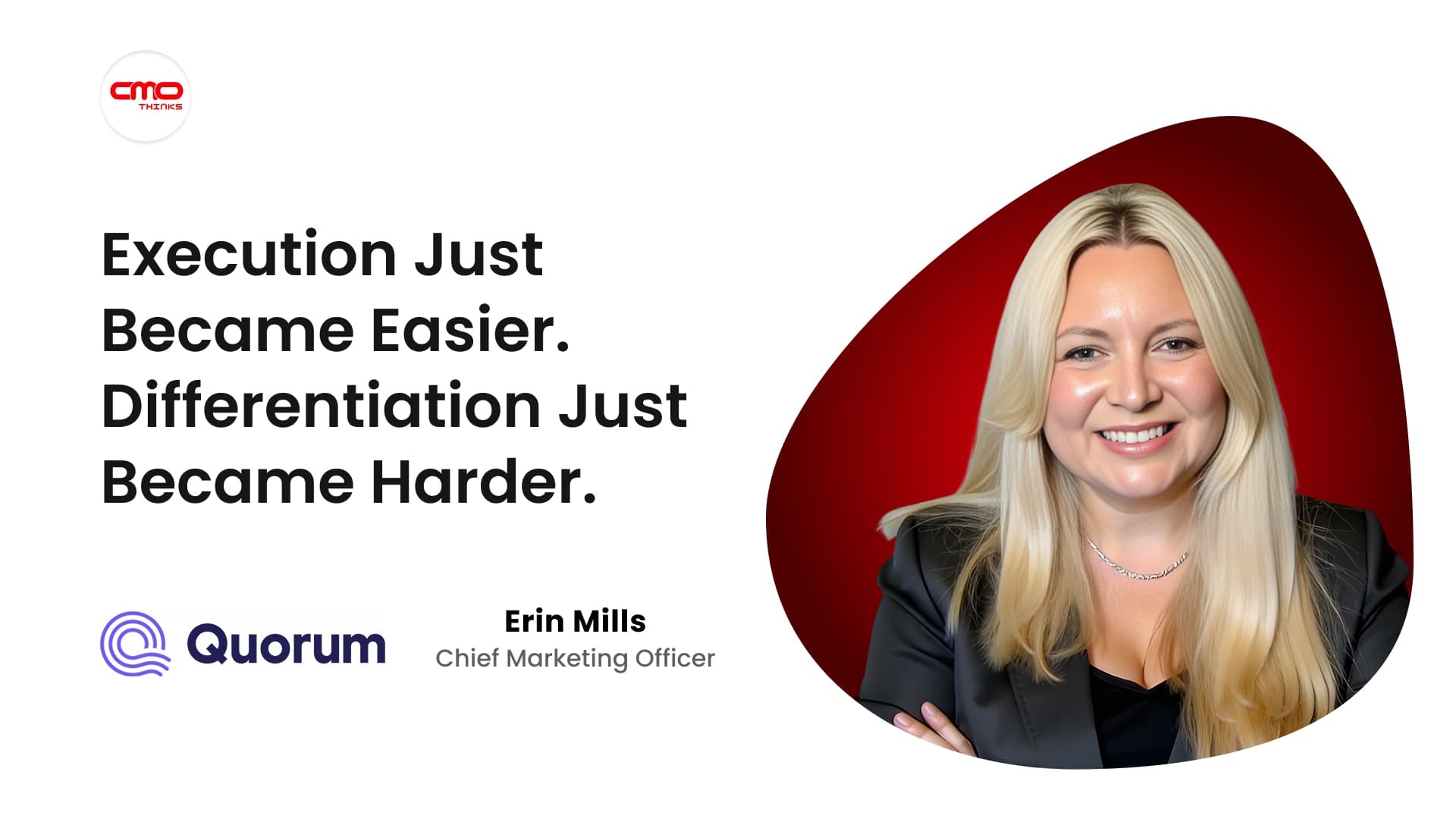
AI will dramatically increase how much content, outreach, and analysis every company can produce. Execution gets easier; differentiation gets harder. When everyone can make more, "more" stops being an advantage. The edge shifts to customer insight, strategic focus, proprietary data, and the ability to make better decisions faster.
CMOs are also going to own more of the go-to-market system whether they want to or not. The lines between marketing, sales, customer success, product, and rev ops keep blurring. If you define your job narrowly around brand or demand gen or comms, you're going to have a hard time showing your full value.
The one I worry about most is organizational readiness. A lot of companies will buy AI tools without redesigning workflows, fixing their data, or preparing their people, and they'll end up with more technology and no productivity gain.
The CMOs who come out of this well will combine commercial discipline with technical fluency and change leadership. They'll know what AI can do, where it shouldn't be used, and how to turn it into better outcomes for customers and the business. And they'll have learned it hands-on, not from a vendor deck.
Looking ahead, what is your vision for the future of Quorum, and how do you see AI transforming the government affairs and public policy landscape over the next five years?
Our vision is for Quorum to be the AI platform for government affairs. Government affairs teams are dealing with an overwhelming amount of legislation, regulation, stakeholder activity, and political information. The challenge is no longer finding information. It is understanding what matters, what it means for your organization, and what action to take.
Over the next five years, I think AI will take on much more of the time-consuming work that happens behind the scenes. It will help teams monitor issues, identify relevant developments, summarize information, prepare briefings, prioritize stakeholders, and recommend next steps based on an organization’s goals and past activity.
The real value is not simply making those tasks faster. It is giving government affairs professionals more time to focus on the work only they can do: building trusted relationships, understanding political dynamics, influencing policy, and making judgment calls in complex situations.
That is where I see Quorum going. We want to give every government affairs team an AI that understands their issues, their stakeholders, and how they work, while keeping the professional in control of the final decision. AI should not replace the expertise or relationships that drive policy outcomes. It should make that expertise more scalable and allow our customers to spend more time on the highest-value parts of their work.