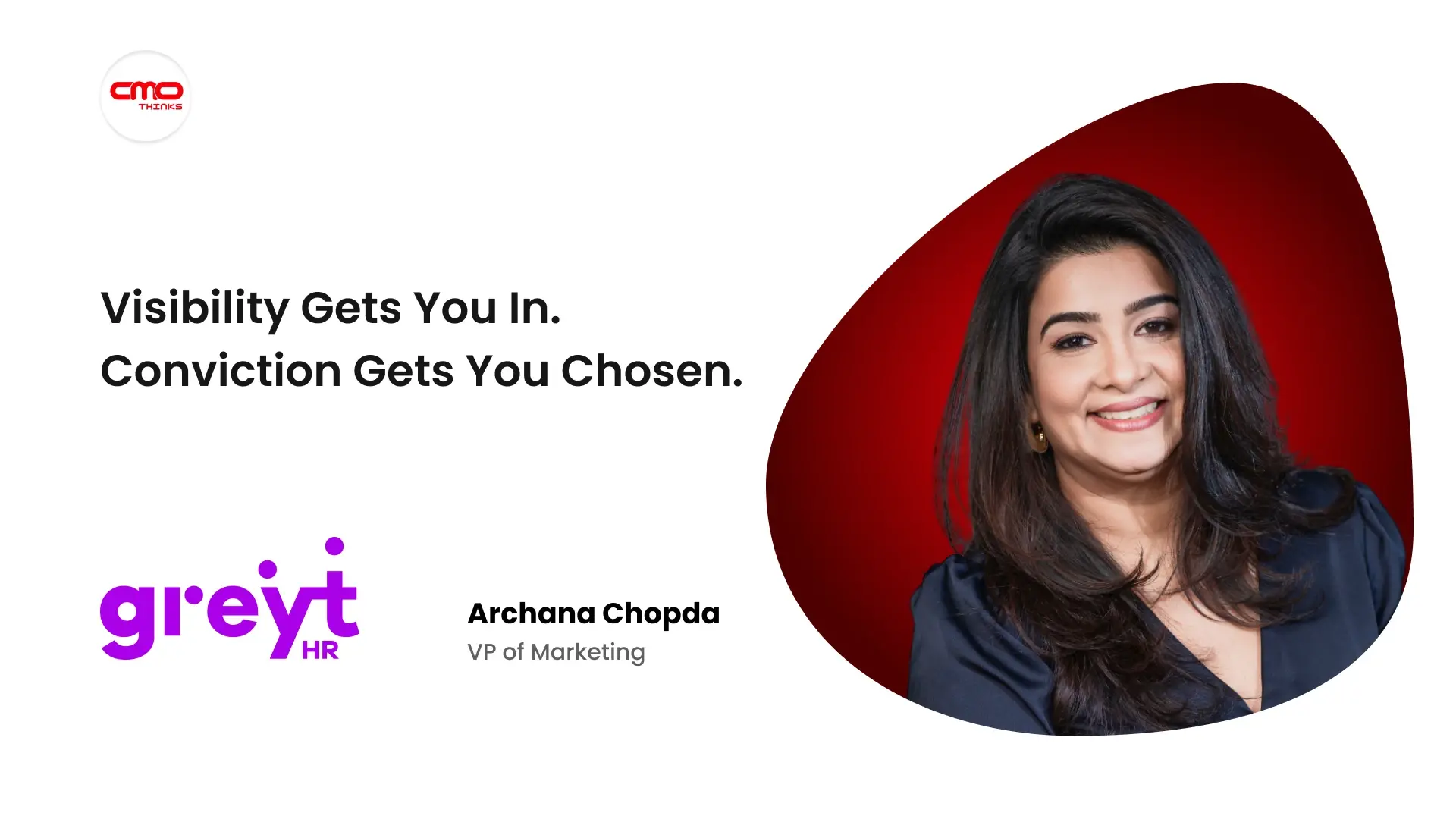
You've led marketing at global tech giants, and now you're driving growth across India, ME, and SEA for greytHR. How has that journey changed your perspective on what great marketing really looks like in today's SaaS landscape?
The biggest shift in my thinking is this: great marketing is not about creating visibility. It is about creating conviction.
Visibility can get a brand into the consideration set. Conviction makes a customer believe we understand their problem, trust that we can solve it, and feel confident putting our product at the heart of an important business process.
That matters even more in B2B SaaS today because buyers have access to more information, more alternatives and more internal stakeholders than ever before. Marketing therefore has to do much more than generate attention. It has to reduce uncertainty and build confidence.
My experience across large global organisations and now in a growth environment like greytHR has shown me both sides of that equation. Scale teaches us the power of brand, data and consistency. Growth environments teach us the importance of staying close to customers, moving quickly and connecting marketing decisions to real business outcomes.
It has also made me much less interested in the old brand-versus-demand debate. Brand creates confidence before the sales conversation begins. Demand converts that confidence into action. We need both.
HR leaders today are juggling compliance, productivity, employee experience and business expectations all at once. Where do you see the biggest disconnect between what organizations need and what the market is actually delivering?
The biggest disconnect is that organizations increasingly want outcomes, while the market still tends to sell features.
An HR leader is rarely waking up thinking, "I need another module." They're thinking about whether payroll will run accurately, whether compliance risk is under control, whether managers have the information they need, whether employees can get things done without depending on HR, and whether the function can contribute more strategically to the business.
Yet HR technology can sometimes become a collection of capabilities rather than a connected operating experience.
The opportunity is to simplify that complexity. Technology should reduce the number of things HR has to think about, not add another layer of administration. That's an important part of how we think about the category: HR and payroll processes are complex, recurring and business-critical, so the value of technology lies in making them more reliable, connected, and intuitive.
For marketers in this space, it also means moving the conversation away from "what the software has" and towards "what becomes possible for the organization because the software exists." That's part of why we've interacted closely with hundreds of customers through a strong advocacy program and developed more than fifty case studies this year, because a real customer describing what changed for them makes that argument far better than any feature list could.
Buying an HRMS is no longer just an HR decision. Finance, IT and several other functions now have a seat at the table. How has that changed the way greytHR positions its platform and engages buyers?
It has changed marketing from addressing a persona to building confidence across a buying group.
The CHRO may be thinking about employee experience, adoption and HR productivity. The CFO is looking at payroll accuracy, compliance and economics. IT is evaluating security, integrations and architecture. And business leaders ultimately want to understand whether the investment will help the organisation operate better.
These are very different questions, but that does not mean we should create four completely different stories. The platform story has to remain consistent. What changes is the lens through which we demonstrate value. That means we need a much deeper understanding of how decisions are actually made. Our website, customer stories, events, sales conversations, product demonstrations, and proof points all need to help different stakeholders answer the questions that matter most to them.
This is why I believe modern B2B marketing is becoming less about acquiring a lead and more about enabling a decision.
A lead may enter the funnel as one individual. A serious B2B buying decision rarely ends there. Our job as marketers is to help a group of people with very different priorities arrive at a shared level of confidence.
Regional expansion often exposes assumptions that worked in one market but fail in another. What's something you've had to unlearn while building marketing across India, the Middle East and Southeast Asia?
I had to unlearn the idea that a successful playbook travels well simply because the brand does.
Brand principles can and should travel. Playbooks need to earn their place.
HR technology makes this particularly clear because the category itself is highly local. Regulations, payroll practices, workforce structures, buying behaviour and expectations of service can vary significantly across markets.
So I no longer think of localisation as taking something that worked elsewhere and adapting the language or creative. I think of it as starting with the customer again.
We need to ask: What problem carries the greatest urgency in this market? Who influences the decision? What creates trust? What proof does the buyer need? How important are local expertise, relationships, self-service, implementation or compliance knowledge in that decision?
Those answers can change considerably across India, the Middle East and Southeast Asia – and even across customer segments within the same market. The real discipline is knowing what should remain constant and what should adapt.
Every board wants predictable growth, but markets rarely behave predictably. When external conditions shift, what's the first thing you revisit: your messaging, your GTM strategy, or your investment priorities?
The first thing I revisit is the customer assumption underneath the plan. Messaging, GTM, and investment decisions are all downstream of that.
When a market shifts, I want to understand what's changed for the customer. Has the problem become less urgent? Has the buying committee changed? Are budgets tighter? Has the definition of value shifted? Is the customer still interested but taking longer to decide?
Only once we understand that should we touch the marketing machinery. Sometimes the answer is messaging, because the value proposition needs reframing. Sometimes it's GTM, because the route to market or segment priority has shifted. And sometimes the strategy is right, but investment needs to move toward the channels showing stronger intent.
The danger in uncertain periods is reacting to every short-term signal. Predictable growth doesn't come from pretending the market is predictable. It comes from a strong operating rhythm: listening closely, testing quickly, measuring honestly, and knowing which parts of our strategy should hold steady while others adapt.
Do you think the next generation of CMOs will be remembered more for creative storytelling, commercial acumen, or their ability to orchestrate AI-driven organizations?
I don't think future CMOs will have the luxury of choosing one.
Creativity stays important because differentiation is getting harder. Commercial acumen becomes non-negotiable because marketing will increasingly be expected to demonstrate its contribution to growth. And AI is already fundamentally changing how marketing organisations research, create, personalise, analyse and execute.
The real differentiator will be orchestration. The CMO of the future needs to bring together brand, data, technology, customer understanding, sales alignment and AI, while still holding onto something machines can't manufacture easily: judgment.
AI can generate hundreds of variations. It can surface patterns in customer behaviour. But deciding which idea the brand should stand behind, and which opportunities are worth pursuing, still requires human judgment.
The strongest CMOs will be commercially minded storytellers who use AI as an amplifier. Technology will make marketing faster. The CMO's job is to make sure it also becomes smarter, more distinctive, and more human.