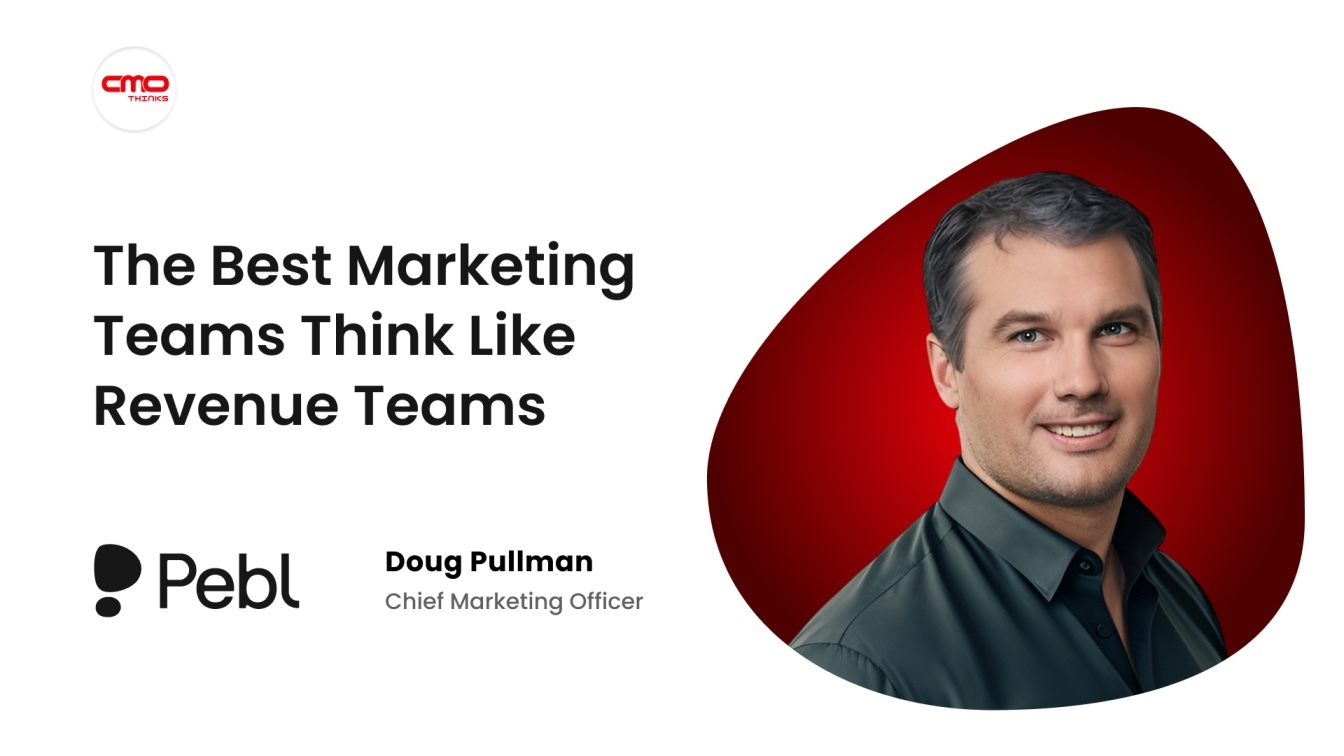
You’ve spent more than 25 years building and scaling marketing organizations. Looking back, what experiences or lessons have had the greatest influence on your approach to modern B2B marketing leadership?
The biggest lesson is that marketing only earns influence when it drives business outcomes. Early in my career, marketing was often measured by activity—campaigns launched, events attended, leads generated. Today, those are inputs, not outcomes.
I’ve learned that the best marketing organizations think like business operators. They understand the company’s financial model, sales process, customer journey, and product roadmap. Every investment should have a clear connection to growth.
I’ve also become increasingly convinced that speed is a competitive advantage. Markets move faster than annual planning cycles. Great marketing teams test quickly, learn quickly, and aren’t afraid to stop doing things that no longer create value.
Finally, leadership is less about having the best ideas and more about creating an environment where great ideas can come from anywhere. The strongest teams challenge assumptions, embrace experimentation, and remain relentlessly accountable for results.
Throughout your career, you’ve built high-performing marketing engines that generated significant pipeline growth. What core principles do you believe are essential for creating a sustainable revenue-driving marketing organization today?
Everything starts with alignment around revenue. Marketing cannot operate independently of sales, customer success, or product. The best organizations share common goals and measure success the same way.
There are several principles I consistently come back to and push my teams to learn:
- Revenue over vanity metrics. Pipeline, customer acquisition, expansion, and retention matter more than clicks or impressions.
- Operational excellence. Great strategy fails without strong systems, clean data, and disciplined execution.
- Customer obsession. Every campaign should solve a real customer problem rather than simply promote a product.
- Continuous optimization. The highest-performing organizations never assume today’s playbook will work tomorrow.
- AI as an accelerator. AI should remove repetitive work so marketers can spend more time on strategy, creativity, and customer understanding.
Sustainable growth comes from building repeatable systems rather than relying on one successful campaign.
Many organizations struggle to balance long-term brand building with short-term revenue goals. How do you approach this challenge, and what metrics help you determine whether the balance is right?
I don’t believe brand and demand are competing priorities. The strongest demand generation programs are built on strong brands.
Brand reduces friction. It lowers acquisition costs, improves conversion rates, increases win rates, and creates trust before a prospect ever speaks with sales.
That said, every company has quarterly commitments, so the portfolio has to be balanced. I typically think of marketing investments across three horizons:
- Immediate pipeline generation.
- Mid-term demand creation.
- Long-term brand equity.
The mix changes depending on company stage, but eliminating brand investment to hit quarterly numbers is almost always borrowing from future growth.
I measure that balance through both leading and lagging indicators. Pipeline generation and revenue remain critical, but I also watch branded search growth, direct traffic, share of voice, win rates, customer acquisition cost, and customer lifetime value. When brand investments are working, those metrics improve together over time. It’s the relationship between the CMO and CFO that is critical. CFO has to listen and the CMO has to be able to articulate why. Otherwise you get into the trap of looking at Marketing effectiveness channel by channel activity versus marketing as a whole.
AI is rapidly reshaping the marketing landscape. How do you see AI changing the way marketing teams operate, and where do you believe marketers should focus their efforts to create the most value from AI-driven technologies?
AI is fundamentally changing how marketing work gets done.
Historically, marketers spent enormous amounts of time producing work. Increasingly, our role is becoming one of directing, validating, and improving work produced by AI.
I see AI creating value in three major areas.
First, operational efficiency. AI can automate reporting, campaign execution, personalization, content creation, and workflow management.
Second, decision support. AI enables marketers to analyze much larger datasets, identify patterns, predict outcomes, and surface recommendations that would otherwise take weeks.
Third, customer experience. AI makes truly personalized engagement possible across every stage of the customer journey.
The biggest mistake organizations can make is viewing AI as simply another productivity tool. The real opportunity is redesigning how marketing operates from the ground up. Which requires both team and individual roles to change and adapt.
The marketers who thrive won’t necessarily be the best prompt writers—they’ll be the ones who combine strategic thinking, creativity, business judgment, and AI to produce outcomes that weren’t previously possible.
As marketing becomes increasingly data-driven, leaders often face the challenge of turning large volumes of information into actionable insights. How do you ensure that data supports better decision-making rather than creating additional complexity?
More data does not automatically create better decisions.
I’ve found that the most effective marketing organizations start with the business question before looking at the data. If you’re not clear about the decision you’re trying to make, dashboards simply become noise.
I’m a strong believer in simplifying measurement. Every executive dashboard should answer a handful of fundamental questions:
- Are we growing?
- Are we generating efficient pipeline?
- What’s working?
- What’s not working?
- What action should we take next?
If a dashboard can’t answer those questions, it’s probably measuring too much.
The goal isn’t reporting. It’s action. Every metric should have an owner, an expected range, and a decision attached to it. It’s why attribution doesn't work. My trick is to ask the team what decision they think they should make, and then have them go look at the data to determine if they would have made a different decision, 99 times out of 100 - the answer is the same, and over time they start to trust themselves and their own decisions-making again.
Building and leading successful teams has been a recurring theme throughout your career. What qualities do you look for when developing marketing talent, and how do you foster a culture that encourages innovation and accountability?
The qualities I value most aren’t necessarily technical skills—they’re mindset.
I look for people who are curious, adaptable, commercially minded, and willing to challenge conventional thinking. Marketing, especially now, changes too quickly for expertise alone to be enough.
I also value ownership. High-performing marketers don’t wait to be told what to fix. They identify problems, propose solutions, and execute with urgency.
To build the right culture, I focus on three things.
First, clarity. Everyone should understand what success looks like.
Second, autonomy. Give talented people room to make decisions and learn.
Third, accountability. We celebrate wins, but we also openly discuss what didn’t work because that’s where improvement happens.
Innovation doesn’t come from removing accountability. It comes from creating an environment where people feel safe experimenting while remaining responsible for outcomes.
Pebl helps organizations hire, manage, and scale talent globally while navigating complex compliance requirements. From a marketing perspective, what opportunities and challenges do you see in educating businesses about the evolving future of global workforce management?
The global workforce has fundamentally changed.
Companies are no longer hiring within commuting distance of their headquarters—they’re hiring wherever they can find the best talent.
That creates enormous opportunity, but it also introduces complexity around compliance, payroll, taxation, benefits, and local employment regulations.
One of marketing’s biggest responsibilities is making that complexity understandable. Buyers don’t want to become employment law experts—they want confidence that they can hire globally without unnecessary risk or using or new campaign - “Hire like a local, even if you have only been there in your dreams.”
Another opportunity is helping organizations recognize that global hiring isn’t simply about compliance. It’s a growth strategy. Accessing talent worldwide allows companies to build stronger teams, enter new markets faster, and remain competitive in industries where specialized skills are increasingly scarce.
As AI continues to reshape work, access to global talent will become an even more important competitive advantage.
Looking ahead, what trends or shifts do you believe will have the biggest impact on B2B marketing over the next three to five years, and how should marketing leaders prepare for them today?
Three shifts stand out.
The first is AI becoming embedded in every marketing function. The winners won’t be companies that simply use AI—they’ll be companies that redesign their operating models around it.
The second is the continued rise of buying experiences over marketing channels. Buyers increasingly expect personalized, self-directed journeys that move seamlessly between digital experiences, communities, sales interactions, in-person experiences and AI assistants.
The third is growing accountability. Marketing will continue moving closer to revenue ownership. CMOs will increasingly be expected to operate with the same financial discipline as any other executive.
For marketing leaders, the preparation starts now. Invest in AI capabilities, simplify your technology stack, improve data quality, build teams that are comfortable with continuous change, and ensure every marketing investment can be connected to measurable business outcomes.
Ultimately, I believe the role of the CMO is evolving from being the head of marketing to becoming the architect of growth. The leaders who embrace that broader responsibility will define the next generation of B2B marketing.