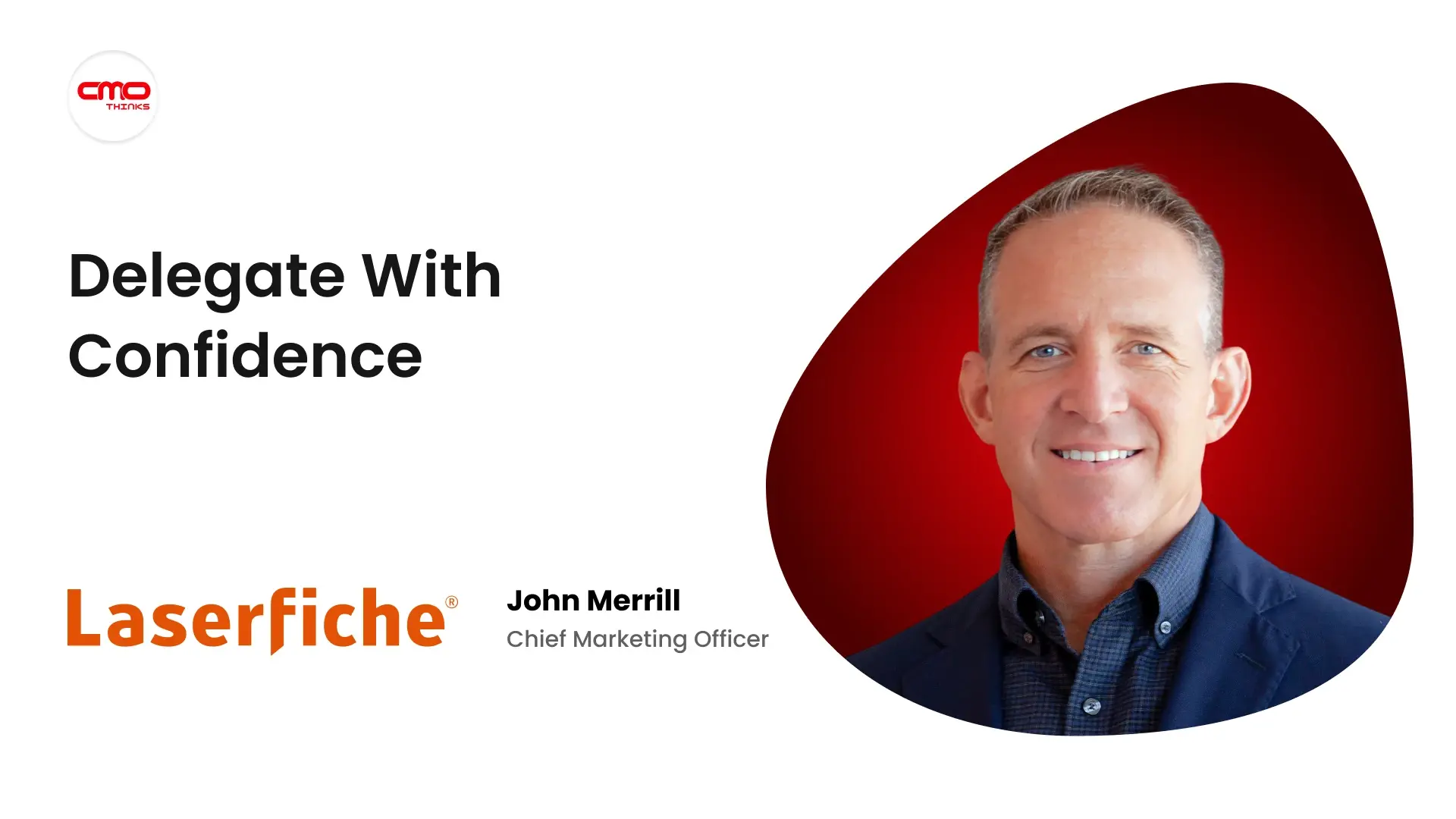
You started your career marketing wireless products at Intel before moving through Xirrus, Nexsan, Imation, and Aerohive Networks on your way to Laserfiche. What's a lesson from marketing hardware and networking infrastructure that turned out to be surprisingly useful for marketing a content management and process automation platform?
One lesson that has stayed with me is that the closer you get to infrastructure, the more important it becomes to explain the human outcome. One must understand the technology, and then explain how it makes life better for people.
When you market networking, you can get caught up in speeds, capacity, and the architecture. But it’s also important to think about what a reliable connection actually enables: a teacher reaching students, an employee serving a customer, or a business opening a new location. That’s where the technology becomes meaningful.
At Laserfiche, the same principle applies. A document contains information someone needs to do a job. A workflow connects that information to a decision or an action. AI opens up new possibilities for understanding that information and helping the work move forward faster than ever.
That’s a powerful progression. We’re helping organizations turn the documents they already have into knowledge and the capacity to do more—to serve people faster, make informed decisions, and give employees time for work that requires their judgment.
My experience in infrastructure also taught me to respect the foundation. Reliability, security, and integration matter because customers are building their operations around your technology. The vision earns their attention. Confidence in your ability to deliver earns their trust.
You've argued AI solutions need to be value-driven. What's an AI feature you've seen a competitor ship, or considered shipping yourselves, that you passed on because it was impressive in a demo but didn't actually solve a real customer problem?
Right now, most AI solutions hand customers the grunt work. They deliver a blank canvas that organizations have to configure and govern themselves. It’s why so many organizations fail to see true ROI from AI; they don’t know how to design the proper parameters or governance.
Organizations today need governance and permissions that are set up correctly from the start, not retrofitted after the content has already piled up. Too many companies are rushing AI features into production without foundational systems in place, then paying for it later when they must rebuild access control across years of unstructured content.
When automated filing systems and guardrails are baked into technology from the very beginning, organizations won’t need to revisit permissions or safety parameters down the line.
Laserfiche was just named a Leader in the 2026 Gartner Magic Quadrant for Document Management. What does that recognition change about how you position the company against competitors, and what does it not change?
Recognition like this is so valuable because it confirms that we are a trusted platform when potential customers are searching for the right solution to address their content management pain points.
When we’re positioning ourselves, we really focus on celebrating the third-party validation from customers and analysts because it adds credibility and confirms we’re a solution that prospects should consider. It doesn’t change our core offerings. We are always true to what we do, and what we deliver.
Content management and business process automation are not naturally exciting categories to market. How do you make a document workflow platform sound like something worth paying attention to, without resorting to hype the product can't back up?
We let customer stories carry the message.
Many of our customers work in industries that need more regulation and compliance as they adopt new technology, so they need to get it right.
It’s why we’re focused on delivering solutions that work and solve the bottlenecks slowing organizations down.
For example, we’re seeing cities improve public records request turn times; universities are improving workflows with process automation, and healthcare organizations are improving patient care with improved documentation systems, to name a few.
These practical, real-world results are not only compelling, but they have a direct impact on everyday jobs, which is rewarding to witness.
You've spoken about servant leadership and 'being the boss of your career.' How does that leadership philosophy actually show up in how you structure and run your marketing team day to day?
For me, leadership begins with a question: what do the people on my team need from me to do their best work?
Sometimes they need clarity. Sometimes they need resources, coaching, or someone to remove an obstacle. And sometimes they need me to step back and let them lead. Knowing the difference is a big part of the job.
I believe in giving people ownership of an outcome. If someone owns a campaign, they should understand the audience, the business objective, and what success looks like. Then they need the authority to bring their ideas and judgment to the work. That’s how you build leaders throughout a team.
Being the boss of your career is the other half of that relationship. I can support someone’s growth, but they have to participate in it: seek feedback, develop new skills, and take on a challenge. With AI changing how we work, curiosity and adaptability are becoming essential career skills. We need humans to think, create, and act. AI will enable us to do it faster.
Day to day, I want our conversations to make the work better and more enjoyable. AI will enable us to do things better, faster, so we can then return home after the workday to enjoy life, family, friends, and community.
Most of us work to live, not live to work. At the end of our lives, it will be about relationships and reflecting on things we accomplished, learned, and help to create —not the amount of hours we worked in an office cubicle.
You can have high expectations and care deeply about people. In my experience, those two things reinforce each other.
You joined Laserfiche in 2022 to help accelerate global adoption of its solutions. What has the marketing organization had to unlearn or rebuild since then as AI reshaped what customers expect from a content platform?
We’ve had to challenge how we explain the value of a content platform. AI has expanded what customers believe is possible, and marketing has to help them understand how to turn that possibility into progress.
Think about the evolution.
First, organizations needed to digitize and organize their documents. Then they needed to connect that information to business processes. Now, AI can help interpret the information and take steps within those processes. Each stage builds on the foundation of the last. We want the vast amount of unstructured data that organizations have to mean something. It should empower them to gain insights that enable better services for their customers.
That changes the conversation. A customer wants to know: can this help us process an application faster, reduce manual work, onboard an employee quicker, or make better use of what we know? Our job is to make the connection between the capabilities and the outcomes clear.
It also means explaining trust as clearly as we explain innovation. What can an agent access? What is it authorized to do? When should a person review its work? Those are essential questions for enterprise adoption.
The marketing discipline I want is to start with is outlining the right problem, showing a practical path forward, and learning alongside customers, partners, sales, and product. We’re helping people envision a new way of working and understanding the steps they can take to get there.
What's a marketing 'best practice' from earlier in your career, in hardware, networking, or storage, that you think is actively bad advice for SaaS and cloud-native platforms today?
I’d challenge the idea that marketing’s job is complete when the customer fills out a form or buys the product or service. In SaaS, the purchase is the beginning of a relationship that needs to keep earning its value.
In hardware, marketing often centered on the next product launch and the next buying cycle. You built awareness, demonstrated an advantage, and helped win the order. In a cloud platform, customers continue to discover, adopt, and evaluate capabilities throughout the relationship. Our role to show value and that building trust never ends.
That means marketing has an ongoing role in customer success. Education helps someone put a capability to work. A customer story helps them imagine another application. A community gives them people to learn from. Partners help turn that understanding into solutions suited to their organization.
As AI expands what a platform can do, that responsibility grows. A feature only creates value when a customer understands it, trusts it, and uses it successfully to improve what they do.
So, I want us to think about growth across the entire relationship: acquisition, adoption, retention, and expansion. Leads and pipelines still matter. We also need to understand how our work helps customers achieve more over time.
The best growth story is a customer who succeeds, expands their use, and helps someone else see what’s possible.
Marketing has a role in making that happen.
How do you decide what stays consistent in Laserfiche's brand story across the public sector, financial services, healthcare, and other verticals you serve, versus what needs to flex by industry?
My rule of thumb is that the brand promise stays consistent.
The core of our business ethos, and the quality of the product that we deliver, doesn't change based on the industry or the problem you are solving. If that story shifted each time we changed audiences, it wouldn't be a brand.
What's one prediction about AI in enterprise content management or business process automation you're confident about for the next two years that most people in the industry would currently disagree with?
Here’s my prediction: Over the next two years, the strongest enterprise AI deployments will give agents, or digital employees, carefully defined responsibilities. The ability to set clear yet useful boundaries will become a competitive advantage.
A lot of the excitement centers on how autonomous an agent can become. I think the more consequential question is how confidently an organization can delegate meaningful work.
Take invoice processing. An agent could read the document, extract information, check supporting records, and route an exception to the right person. That can change the economics and speed of the process while keeping financial authority where the organization wants it.
Now imagine that approach across HR, procurement, or public services: agents handling defined tasks, workflows coordinating the steps, and people applying judgment where it matters. That’s the future I see.AI agents will have the ability to work together within a system people can understand and govern.
It also gives content management a bigger strategic role. An agent needs reliable information, business context, and appropriate access. The quality of that foundation will shape the quality of the work it can perform.
I believe customers will spend more time evaluating platforms by the work they can confidently entrust to them. That’s a significant shift, and a tremendous opportunity to help organizations build capacity and serve people better. Today, I see AI as an enthusiastic intern, but moving forward we need to properly manage it so it can evolve into a trusted, valuable asset.