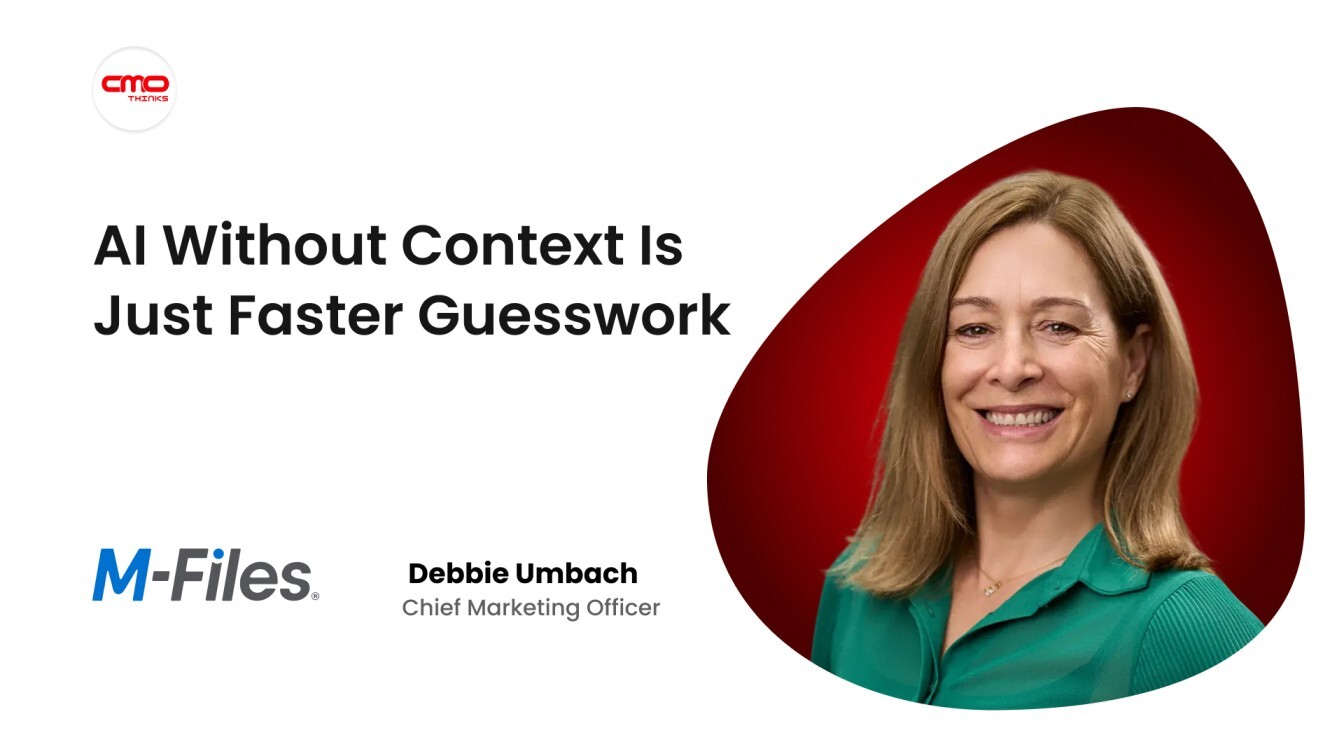
Throughout your career, you've consistently helped organizations achieve rapid revenue growth and significant customer expansion. What core marketing principles have remained constant for you?
Stay close to the customer. Know the ideal customer profile cold, listen for their real problems, and let that drive your initiatives.
Get positioning right first. Once you're clear on how you uniquely solve the customer's problem, messaging and campaigns flow from it.
Measure marketing on pipeline, not volume. Further, ensure the team thinks about campaign ROI and leans into what’s working and stops what’s not working to drive efficient growth. Pipeline is what sales actually cares about, and it's what makes them see marketing as a partner.
M-Files is transforming document management through its context-first, AI-native platform. How is this approach changing the way organizations manage enterprise knowledge, and what opportunities does it create for business leaders looking to improve productivity and decision-making?
Most organizations still manage documents as assets to store and find through folders, versions, and tags. That breaks down with AI, because a folder can't tell an agent what a document means, who it belongs to, or whether it's safe to act on. M-Files takes a different approach, connecting every document to the customers, projects, contracts, and decisions that give it meaning, so people and AI agents work from one trusted, governed source of truth.
That's the real opportunity for business leaders. Bolting AI onto a digital filing cabinet just amplifies bad data faster. Because context and permissions are already built in, a contextual foundation lets AI actually reason to summarize a contract accurately, flag the right policy, or route an approval. That means faster decisions with less manual searching and AI you can trust on processes that matter.
As AI becomes increasingly embedded in enterprise software, how do you see customer expectations evolving when it comes to content management, automation, and intelligent business workflows?
Expectations have shifted from 'help me find it' to 'handle it for me.' Search was the bar for years; now customers expect systems to understand context well enough to act without being asked, whether it’s routing an approval, flagging a compliance gap, or summarizing a contract. That raises the stakes on trust: automation only earns adoption if people believe the underlying data and logic are sound. Organizations that succeed won't just be the most automated, they'll be the ones who make that automation explainable, trustworthy, and governable.
Having extensive experience in product positioning, what strategies do you believe technology companies should prioritize to effectively communicate complex AI innovations without overwhelming potential customers?
Lead with the problem, not the model. Nobody outside a product team cares whether something uses machine learning or a certain agent model. Customers care whether a task that used to take an hour now takes five minutes, while producing high-quality results. I guide my team to translate AI capabilities into value for our customers, and we always strive to avoid buzzwords.
You've managed marketing investments ranging from $1 million to $45 million while maintaining a strong focus on ROI. How do you balance long-term brand building with the pressure to deliver measurable pipeline and revenue outcomes?
I treat brand and pipeline as the same investment with different time periods. Every budget, whether $1 million or $45 million, gets split with a clear owner for near-term pipeline contribution and a smaller, protected allocation for brand and category work that won't show up for two or three quarters. The discipline is reporting them differently. I measure brand awareness through a traditional awareness survey and as of recently, monthly AI Share of Voice. For demand gen, I report on pipeline and bookings. It’s important to not let short-term pressure quietly cannibalize the brand budget when a quarter gets tight. Boards trust that structure once they see it hold up under pressure, which is what buys patience for the long game.
Looking ahead, what emerging trends in enterprise content management do you believe will have the greatest impact on how organizations operate and compete over the next five years?
The biggest shift will be a move from managing documents to managing context. Enterprises have spent decades organizing files; the next five years will be about organizing relationships between documents, people, projects, and decisions so that systems can reason across them the way a knowledgeable employee would. Content management stops being a filing problem and becomes a knowledge-graph problem. Organizations that make that shift will compete on how fast their systems can connect the dots and provide trusted business impact and governed risk.