Key Highlights
• The industry’s biggest communication gap: Wilson says the industry needs to explain better what digital infrastructure means for local communities. He says legitimate questions about energy, water, housing and environmental impact deserve transparent answers, while misconceptions should be met with facts and a more balanced conversation.
• Action over advertising: The answer isn’t simply better marketing campaigns, he says. He points to practical steps such as supporting local water initiatives, helping households improve energy efficiency and investing in the communities around campuses.
• What customers really ask about: In first conversations, Wilson says, the topic is power, capacity and availability, and whether they can be delivered in Europe within the right timescale. Customers want confidence that infrastructure can scale with their ambitions.
• Simplify, don’t oversimplify: Different audiences need different levels of detail but should understand the same underlying proposition. Technical stakeholders look at power and cooling, commercial leaders at timelines and value, and communities at what the project means for their area.
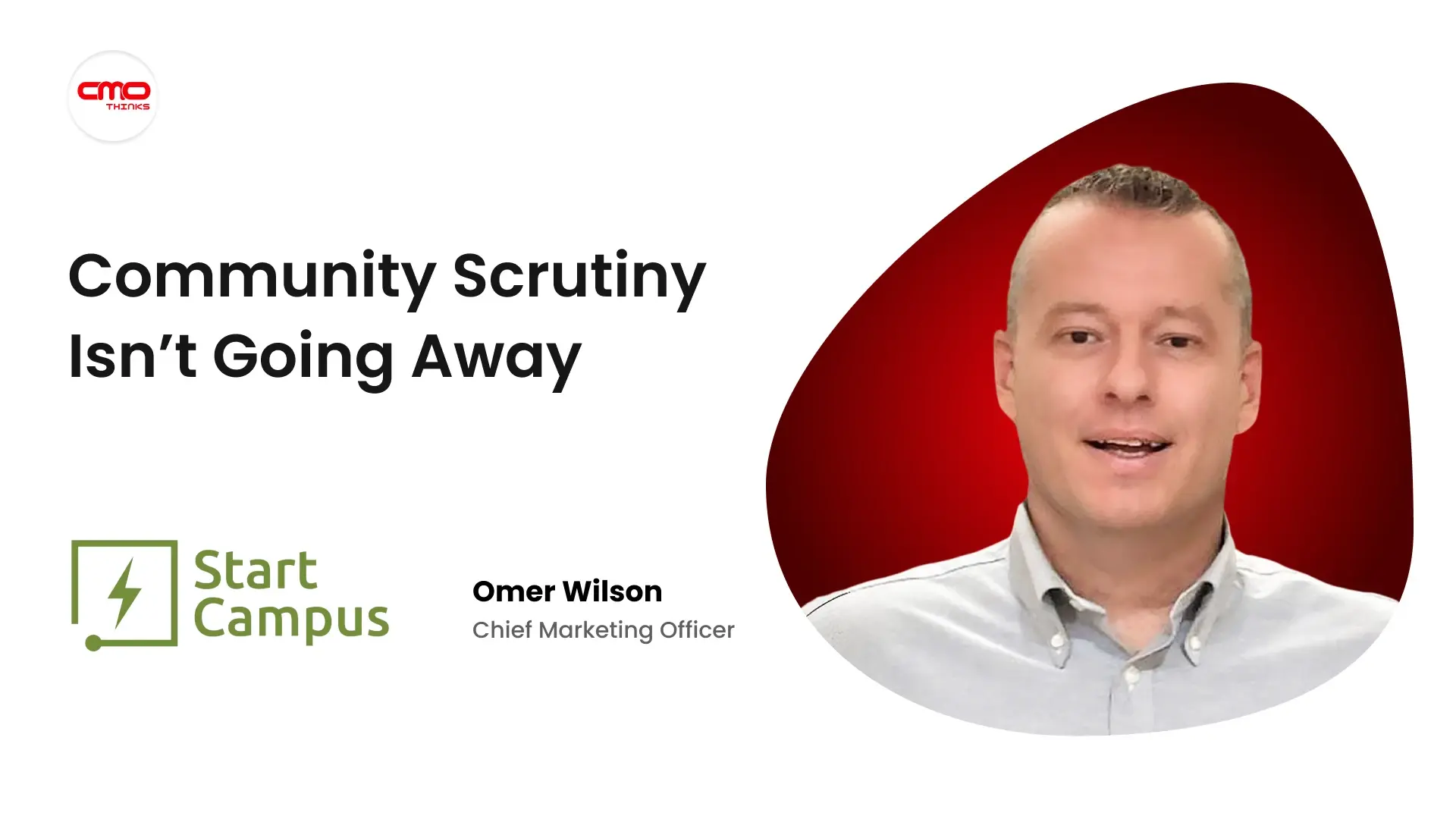
• Scrutiny is permanent: Data centres were once largely behind the scenes, but AI has made them visible. Wilson says marketers should expect continued community scrutiny and some opposition, and should treat communication and engagement as long-term responsibilities, not short-term campaigns.
You've worn multiple hats over the last 25+ years, from technology and consulting to media and now one of Europe's biggest digital infrastructure projects. What have you brought from that journey into your CMO role at Start Campus?
Around 15 of my 25+ years working have been spent in the data centre industry, so there's a direct crossover of experience that is hugely relevant to my role at Start Campus. I've seen the sector evolve through different phases, from the early days of outsourced infrastructure to the growth of cloud computing and now the AI revolution. Having worked with different operators, across different regions and markets, I've developed a strong understanding of the industry, its customers and how its messaging needs to evolve.
My earlier experience in technology, including at IBM, and in consulting has also been valuable. It gives me a broader perspective on how businesses adopt technology, how markets change and how to communicate complex propositions to different audiences.
One of the biggest lessons from that journey is that every major technological shift brings new opportunities, but also new questions and challenges. We saw that with cloud, and we're seeing it again with AI. At Start Campus, I can draw on those experiences to help position the business for the long term, while recognising that the scale and pace of change we're experiencing today require us to think differently.
AI is driving unprecedented demand for digital infrastructure, but where do you think the industry is still getting it wrong? What's the challenge customers are wrestling with that deserves more attention?
I think one of the biggest challenges facing the industry is how we communicate the impact of AI and digital infrastructure to the communities in which we operate. This has become particularly important over the past six months, as the debate around AI has intensified.
As an industry, we need to do more collectively to explain what digital infrastructure means for local communities, both in terms of its potential impact and the benefits it can bring. There are legitimate questions around energy, water, housing and the wider environmental impact, and we must address those transparently. At the same time, there are misconceptions about data centres and AI that need to be challenged with facts and a more balanced conversation.
AI is already creating opportunities across healthcare, technology and many other sectors, yet much of the public debate focuses on the risks, the resources required and the financial gains being made by large technology companies. Communities understandably want to know what they will gain in return, particularly when they are hosting infrastructure that enables this growth.
The answer isn't simply to produce better marketing campaigns. We need to demonstrate our commitment through practical action, whether that's supporting local water initiatives, helping households improve energy efficiency or investing in the communities around our campuses. At Start Campus, these are important parts of how we approach our development in Portugal.
We also need to empower independent voices, from local community leaders to people working in other sectors, to explain the benefits and trade-offs in an authentic way. Ultimately, trust comes from transparency, meaningful action and listening to people, rather than simply telling them what we want them to hear.
When a customer sits down with Start Campus for the first time, what's the conversation really about? What are they trying to solve, and how does Start Campus change that equation?
Ultimately, the conversation is about power, capacity and availability, and being able to deliver them in Europe within the right timescale.
AI is accelerating demand for digital infrastructure at a scale that is changing the way customers think about their requirements. They need to know whether the capacity will be available when they need it, whether the infrastructure can support their long-term ambitions and whether the solution is designed to meet the demands of increasingly intensive computing workloads.
At Start Campus, our approach is to address those needs through the scale and ambition of our campus in Sines, Portugal. We're developing infrastructure with the potential to support substantial future demand, while considering the energy, cooling and sustainability requirements that come with it.
For customers, it's about more than securing space. It's about having confidence that the infrastructure underpinning their growth can be delivered at the right scale, in the right location and on a realistic timeline. In a market where access to power and capacity is becoming increasingly important, that confidence is a significant part of the value we offer.
Marketing a hyperscale data campus isn't exactly an impulse-buy exercise. With so many technical, commercial and strategic stakeholders involved, how do you keep the message relevant without oversimplifying it?
The key is to understand that different audiences need different levels of detail, but they should all be able to understand the same underlying proposition.
A technical stakeholder needs to understand the infrastructure, capacity, power and cooling. A commercial decision-maker is looking at delivery timelines, long-term value and the ability to support their business. Meanwhile, local authorities, community representatives and residents need a clear understanding of what the project means for their area.
We shouldn't confuse simplifying the message with oversimplifying the proposition. The challenge is to communicate complex issues in accessible, non-technical language without losing the substance or ignoring the difficult questions.
That requires a coordinated approach across the industry, working with organisations such as the EU Data Centre Association and Portugal's data centre community, as well as technology partners and other stakeholders. We also need to equip trusted local voices with accurate, transparent information they can use to explain the benefits and address concerns.
For me, good marketing in this sector isn't just about speaking to customers. It's about ensuring that everyone who has a stake in the development can understand why it matters, what it involves and how the benefits can be shared. That becomes particularly important as projects grow in scale and their impact on surrounding communities becomes more significant.
You've always had one foot in marketing and the other in futurism. So what's around the corner that marketers in digital infrastructure should already be preparing for, even if the market isn't talking about it yet?
I think the biggest thing marketers need to prepare for is the fact that community scrutiny isn't going to disappear. It's going to become a permanent part of how the digital infrastructure industry operates.
For a long time, data centres were relatively behind the scenes. The industry was growing, but most people didn't necessarily think about the infrastructure supporting their digital lives. AI has changed that. Data centres are now much more visible because they are directly associated with the growth of AI, and that brings greater attention to their energy requirements, environmental impact and role in local communities.
We've seen similar patterns before. When businesses began outsourcing their infrastructure, the sector grew. When cloud computing developed, there were questions about whether physical data centres would remain relevant. In practice, the growth of cloud drove further demand for infrastructure. AI is another major technological shift, but the scale of development today is substantially different from anything we experienced a decade ago.
The difference now is the intensity of community engagement and the sheer size of the projects being developed. We can no longer assume that public concerns will fade as the technology becomes more familiar. Some developments will face opposition, and the industry will need to make its case clearly and consistently.
For marketers, this means moving beyond short-term campaigns and treating communication, transparency and community engagement as long-term responsibilities. We need to explain not just why the infrastructure is necessary, but how it is being developed responsibly and what value it can create for the people living alongside it.
We're at the beginning of what many are calling the AI revolution. Our role is to help the industry mature alongside it.
Ten years from now, AI will have transformed industries we haven't even imagined yet. If Start Campus becomes one of the foundations of that future, what do you hope people will say your marketing got right long before everyone else caught on?
I hope people will look back and say that we got the balance right. We recognised the enormous potential of AI and the infrastructure needed to support it, but we also understood that long-term success depended on developing that infrastructure responsibly and bringing communities along with us.
At Start Campus, we're working towards a development in Sines with a potential capacity of more than one gigawatt. A project of that scale creates a significant responsibility, not only in terms of the infrastructure itself, but also in how we engage with communities, address environmental considerations and communicate the wider benefits.
It's encouraging when we see our campus referenced in discussions around Europe's AI infrastructure ambitions, including conversations about AI factories, as an example of how this development can be approached. That is the kind of recognition we'd like to build on.
Looking back over my career, I've seen how the industry has repeatedly had to adapt to major shifts in technology. The move to cloud taught us that concerns about a new model of computing don't necessarily mean demand will diminish; often, the opposite happens. But each new phase also brings different challenges, and we have to learn from the past without assuming that the future will follow exactly the same path.
Ten years from now, I hope people will say that Start Campus helped demonstrate how to build digital infrastructure at scale while taking the time to get the wider responsibilities right. If we can help establish a model that others across the industry can learn from, and show that technological progress and meaningful community engagement can go hand in hand, then our marketing will have done something much more valuable than simply promoting a business.