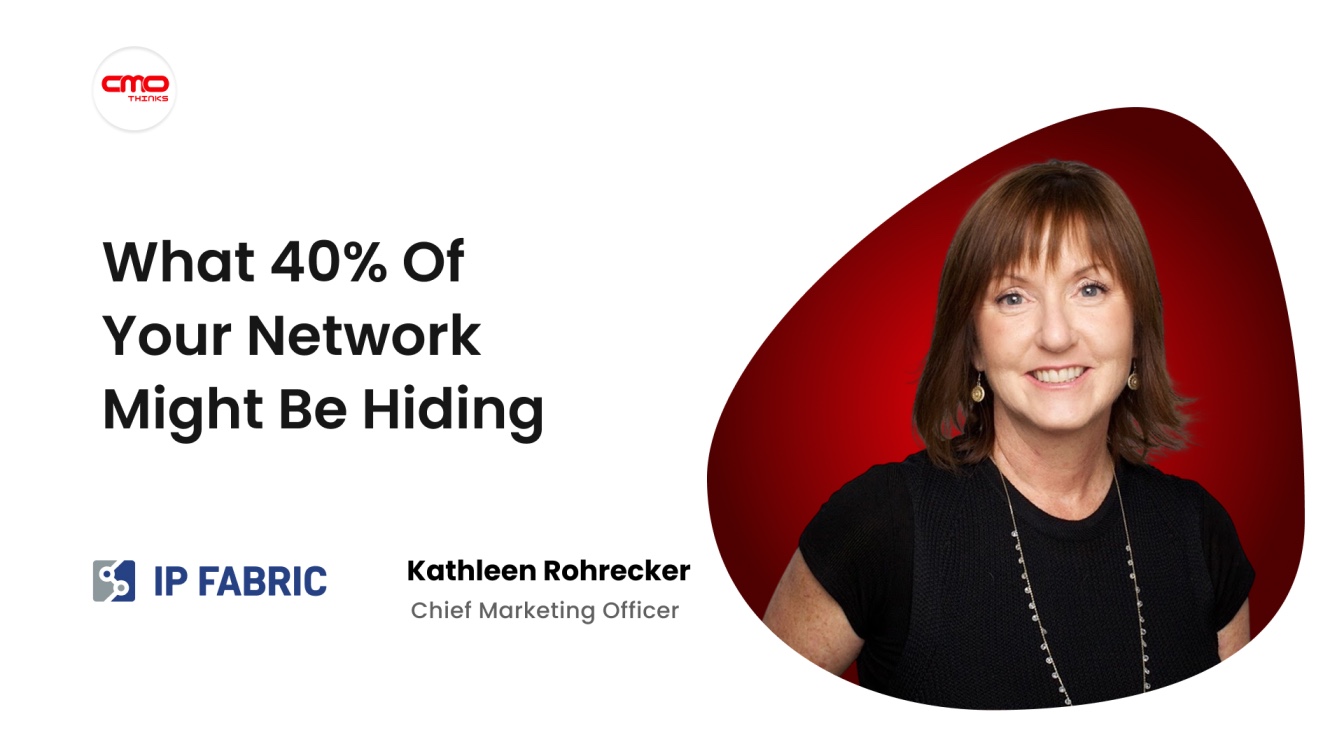
You’ve seen B2B tech companies scale through different stages of growth. How does that experience reflect in your approach at IP Fabric today?
My experience has taught me that the company stage is only part of the story. What matters just as much is market maturity and understanding whether you’re riding an existing wave or helping create one.
Throughout my career, I’ve worked with technical founders building products they believed the market needed. In those situations, success rarely comes from simply generating more demand. It starts with understanding the problem you’re solving, who you’re solving it for, and why your approach is meaningfully different.
At IP Fabric, we’re operating in an emerging category. There is still an element of market education involved, which means our job is not only to communicate what we do, but also to help customers understand why network visibility and control have become foundational requirements for resilience, compliance, and transformation initiatives.
No matter the market, the fundamentals remain the same. You need a deep understanding of the customer problem, the impact it has on the people responsible for solving it, and the outcomes they are trying to achieve.
Coming from a product management background, how do you balance product thinking with marketing storytelling when defining IP Fabric’s GTM strategy?
Being a product manager was career-defining for me. In early roles, I was responsible for what I think of as the “five Ps”: product, positioning, pricing, place, and promotion. This framework still shapes how I think about GTM strategy.
For me, the product is never just the software. It is the documentation, support, onboarding, pricing, and everything required for a customer to achieve the outcome you’ve promised. If you are asking customers to trust you with an important program, every part of the experience matters.
The storytelling comes from understanding what you’re uniquely positioned to do and why that matters. This requires deep engagement with customers. At IP Fabric, we spend significant time speaking directly with both practitioners and executive buyers to understand not only the technical challenges organizations face, but also the business pressures they face.
The most effective messaging comes from understanding how customers describe their challenges, what risks they’re willing to accept, and what outcomes they’re ultimately responsible for delivering. Product and storytelling converge when we connect customer pain points to the solutions IP Fabric provides and clearly communicate the role we play in helping organizations reduce risk, gain confidence in their environments, and operate more effectively.
IP Fabric operates in automated network assurance, a highly complex technical space. How do you simplify and frame that complexity for different stakeholder groups – from engineers to CIOs?
One thing I’ve learned is that technical buyers don’t always want complexity simplified. They want you to meet them where they are. Engineers are evaluating your technical credibility. They want to understand how something works and whether you truly grasp the challenges they’re facing. Executives are looking at those same challenges through a different lens. They’re thinking about resilience, security, compliance, modernization, and cost.
Our job is to connect those perspectives.
At IP Fabric, we increasingly frame the conversation around control. Change, compliance, and cost management all depend on understanding what actually exists in the environment and how it behaves. Engineers experience that challenge operationally every day. Leaders experience it through risk, accountability, and business outcomes.
The underlying problem is the same. The way you communicate it depends on the audience and the responsibilities they carry.
Where do you see the biggest gap today between how enterprises perceive their network environments and how those environments actually behave in reality?
Most enterprises already understand they do not have a complete picture of their network environment and how it operates in production. The bigger issue is that they don’t know how large the gap is between what they believe is true and what is actually happening.
When customers validate their environments, the results are often surprising. We frequently uncover significant differences between documented understanding and operational reality, whether that’s assets, configurations, dependencies, or connectivity. We often see a difference of 20 to 40% or more.
What is most surprising is how many leaders have accepted that uncertainty as part of operating a modern network despite the massive operational and business risk. One of our greatest opportunities in this market is helping organizations understand that they don’t have to accept that risk anymore. Better visibility and control make it possible to operate with a much higher degree of confidence.
IP Fabric positions itself around “continuous validation” and “operational truth.” How do you translate that concept into a clear business value narrative rather than a technical capability?
For us, continuous validation relates back to the point about control. Many organizations have access to plenty of information about their environments. What they often lack is confidence that the information is accurate, current, and complete enough to support important decisions.
Control becomes especially important in three areas: managing change, maintaining compliance, and controlling costs. Every major transformation initiative, whether it’s cloud migration, network modernization, automation, or AI adoption, depends on an organization’s ability to understand the environment and predict the impact of change.
That’s why we focus less on visibility as an end goal and more on what visibility enables and how this translates to business outcomes. When teams have a trusted understanding of their environment, they can move faster, reduce risk, prove compliance, reduce costs, and execute strategic initiatives with far greater confidence.
You describe yourself as a cross-functional connector. How does that philosophy influence how you align product, marketing, sales, and customer success around growth?
Cross-functional alignment starts with a shared commitment to customer success. It cannot be driven by a single department. One of the things I care deeply about is building empathy across functions so teams understand each other’s challenges and priorities.
Marketing needs to understand what sales teams are hearing in the field and where deals are getting stuck. Product teams need visibility into customer adoption challenges. Customer success teams help shape messaging based on what drives long-term value realization.
I also believe cross-functional alignment is not just coming from me; it's a commitment leaders have. It is also critical to hire and surround yourself on your team with people who are also very empathetic to other teams, are excited about their roles and the company, and feel their team is supportive of them.
Cross-functional work becomes more practical when you focus on enabling individuals, not just building frameworks. For instance, how do we make the AE in Chicago successful? How can you help a customer success manager solve problems faster? These small, but mindful actions create a cascading impact across the entire organization.