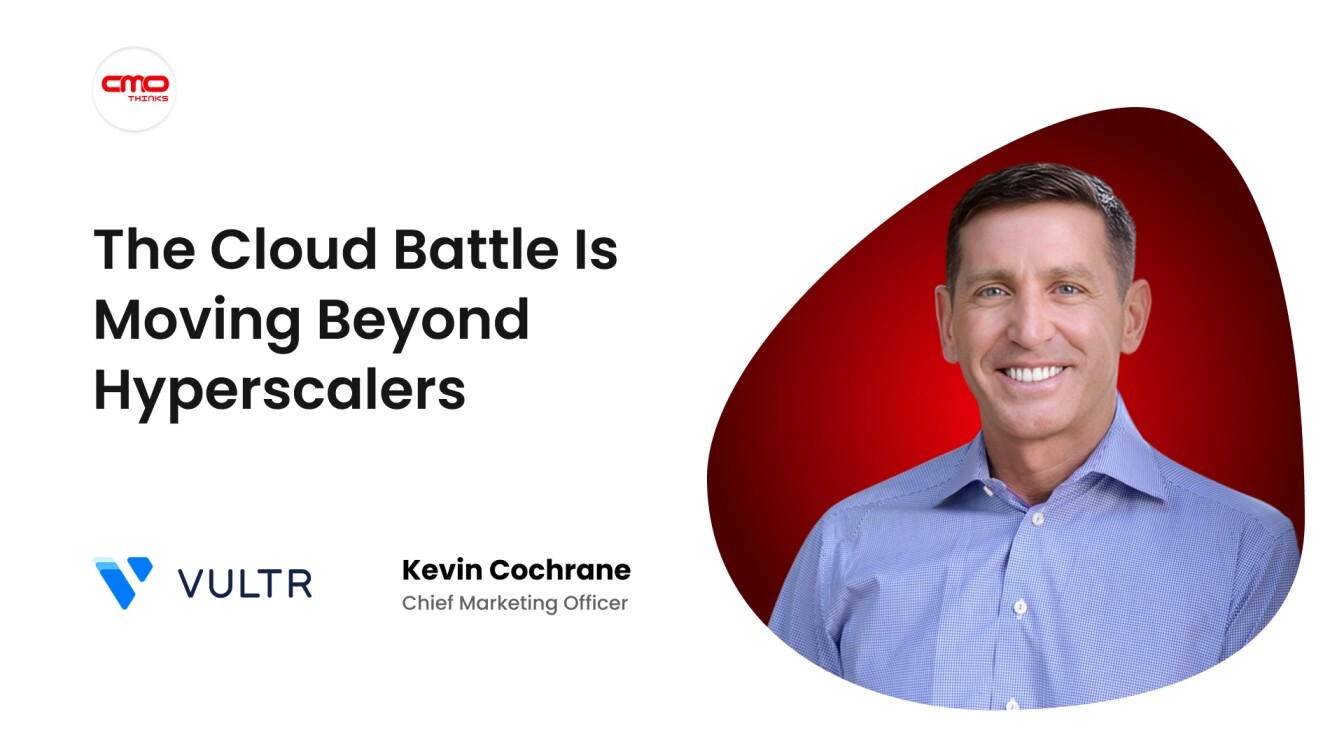
You've witnessed the evolution of the digital experience era firsthand. Which lessons from that journey still shape the way you lead marketing at Vultr?
Witnessing the evolution of the digital experience era has fully impacted how we adapt our strategy at Vultr. Over the last two decades, we’ve built increasingly refined ways to engage customers across digital channels, creating a hyper-granular, real-time context that allows us to personalize outreach to Vultr’s various stakeholders.
If more than 20 years of digital innovation has taught me anything, it’s that technology can bridge the gap between a company’s goals and the connection required to truly reach its audiences. This is what guides Vultr’s people-first strategy, which embraces new technology to support our GTM strategy and meet customers in person to build community. Grounding our marketing strategy in the authenticity of human connection has led to brand values that come from treating customers as people first.
Hyperscalers have long dominated the cloud conversation. Where do you see that narrative starting to change, and why is this the right moment for a platform like Vultr?
The cloud market has primarily been a closed market mainly for hyperscalers. Alternative cloud providers only supported small regional needs or developers that weren’t being serviced by the existing hyperscalers. AI broke open this market, creating more demand for cloud and hardware than ever before. This shift has reenergized the cloud industry by pushing enterprises to reinvent their core infrastructure into AI infrastructure.
As businesses are realizing agentic AI doesn’t only require GPU as a service but a full stack inclusive of networking and cloud compute storage, this is the perfect moment for Vultr. We are not a neocloud because AI infrastructure requires far more and, as a company, we understand that and focus on delivering that to our customers.
Everyone talks about GPUs, but successful AI infrastructure goes much deeper. What capabilities do you think enterprises are still underestimating?
Enterprises are forgetting the fundamentals of what AI is meant to accomplish. To present positive outcomes to a board, teams must understand how to optimize workflows. Building the most advanced GPU or CPU cluster doesn’t matter if it isn’t enabling teams to do real work that moves the business forward. In 2027, the industry will shift from building models to building toward outcomes that matter to leaders, and Vultr will be part of the orchestrated system that engineers that success.
Today's cloud buying committee is bigger than ever. You're speaking to developers, architects, CIOs, and CFOs all at once. How do you build a story that resonates across every stakeholder?
The cloud-buying committee has grown in the past couple of years. The usual group has anywhere between 15 to 20 typical stakeholders, which includes a lot of different stakeholders with different questions and priorities. For example, developers want speed, architects want reliability, while CIOs want seamless integration and CFOs want cost predictability.
The key to enterprise success is ensuring that the individual workflows of the buying committee are optimized and streamlined to deliver business outcomes. At Vultr, we focus on delivering endless possibilities for buyers by offering advanced AI infrastructure and an open ecosystem of third-party services that can be easily deployed across teams.
The strongest enterprise brands often make complex technology feel remarkably simple. How do you simplify without stripping away the nuance that technical buyers expect?
Making complex technology simple is hard. But simplicity shouldn't mean hiding the work or stripping away the substance that technical teams rely on. At Vultr, we simplify execution without hiding the engineering. On the surface, we make delivering AI infrastructure as simple as single-click deployments but beyond that, we pull back the curtain. We equip the entire buying committee with deep technical documentation, rigorous benchmark tests, step-by-step lab exercises, and detailed blueprints.
This distinction is critical: we make deployment frictionless, but we don't treat our buyers like they don't care about the details. By deeply educating technical teams on how the complexity is solved underneath the surface, we empower them with the knowledge to make confident architectural decisions.
If you could leave every enterprise leader with one question before they commit to their next cloud or AI investment, what would it be?
I would ask them: “Is your next cloud partner going to deliver real business outcomes faster, simpler, and more cost-efficiently or are you going to spend the next three years managing the complexity of how to pay for the technology?”
For too long, enterprises have bought raw technology, getting bogged down by opaque pricing structures and complex architectures that slow execution. But the modern buyer doesn't just need to buy tech. They need to buy outcomes, and they need to achieve those outcomes on timelines that match their business goals. When you choose a platform that delivers outcomes in a truly cost-efficient way, you do more than just solve a single workload. You free up capital and momentum to fund your next five AI and digital initiatives. Enterprise leaders should be asking who can help them ship real business value fastest.