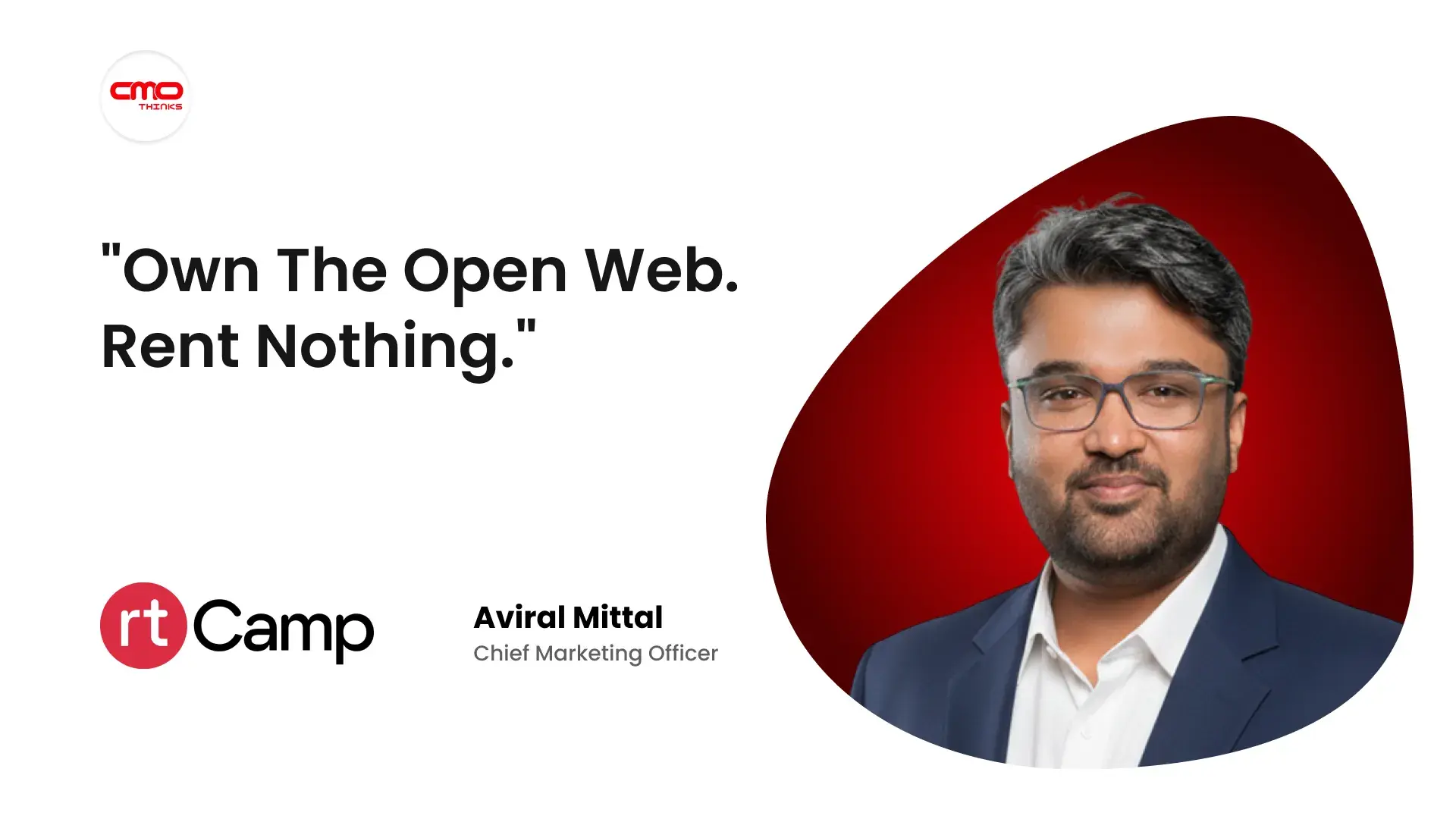
As CMO, you're marketing rtCamp as an enterprise engineering partner powering mission-critical digital experiences. How do you approach your role, and what strategic priorities are shaping rtCamp's growth today?
I see myself playing two roles: First, telling the story of our people, culture and expertise. And second, represent our buyers who are mostly marketers - to empathize and be their voice in our delivery and solutions.
We have been in the business for 17+ years, and are still at the top of our game, delivering enterprise grade solutions with WordPress, and now ERPNext & Frappe. With handpicked engineering talent trained rigorously in our opinionated best practices, we have a team of 200+ professionals that rivals the best globally.
Our CMS solutions are foundational to any enterprise martech stack—ensuring content is published without raising developer tickets, the design remains on-brand, campaigns are launched faster, and the overall team can remain agile with all the right tools at their disposal.
One of our strategic priorities in marketing is the Growth Engineering mindset - where we in marketing own the solutions as first users, and help design tailored solutions that will help real marketing teams in real world scenarios. This helps us create better editorial experiences, actually useful AI use cases, multi-brand solutions and more. We can take these solutions to our clients and since they are mostly marketing teams, they instantly connect with our solutions. For the past two years, that has been one of the key drivers of our growth and our evolving engineering and design practice.
Every business has a website, but few treat it as strategic infrastructure. What misconceptions still exist around enterprise web platforms, and how do they ultimately affect CX, agility, and growth?
I think the biggest misconception is that the website belongs to IT. For most businesses, the website is where marketing launches campaigns, where customers experience the brand, and where a lot of business actually happens. Yet many organizations still treat it as something only developers should touch, and that's where the friction starts.
A headline change becomes a ticket. Launching a landing page means waiting in a queue. Small updates become bigger projects than they should be. None of those feel like major problems on their own, but together they become a tax on growth. Over time, marketing teams start adjusting their ambitions to fit the limitations of the platform instead of asking what would create the best customer experience. I think organizations are confused about who should own the website.
There are other assumptions that still come up. That WordPress is only for blogs. That enterprise automatically means proprietary. That paying more means getting a better platform. I don't think any of those hold up anymore. The best platform isn't the one with the fanciest technology. It's the one that helps your team do their best work.
Enterprise websites now need to integrate with marketing stacks, enable personalization, leverage first-party data, support commerce, and remain easy to manage. How does rtCamp help organizations address these challenges differently?
We start by rejecting the monolith. The market spent a decade believing one stack could own the CMS, personalization, analytics, the CDP, the whole martech layer. In our experience, trying to make one platform do everything often leads to unnecessary complexity and vendor lock-in.
So we build composable. Best-of-breed systems where data flows cleanly between them, and the enterprise assembles the stack it actually needs rather than the one a single vendor happens to sell. WordPress sits at the center as the editorial and experience layer, integrating out to whatever's genuinely best for commerce, data, and personalization.
And why do I think WordPress is the right platform? Because it is truly the most open system. Everything within WordPress can be consumed via APIs by any other system & vice versa. No proprietary platform can compete with this kind of radical openness. You can connect forms, CRMs, CDPs, Analytics or anything that you can think of, with full access to WordPress architecture and the freedom to expose any kind of information to any of these systems.
Open source offers flexibility and freedom, yet enterprise adoption is often slowed by concerns around scalability and governance. How do you reposition open source as a long-term strategic advantage rather than simply a cost-saving decision?
I think focusing only on cost undersells what open source really offers, and it invites the wrong objection. If "free" is the pitch, then "but can it scale, and who governs it?" is a fair thing to ask back.
That's why we usually start the conversation somewhere else. I lead with ownership. When we say no vendor lock-in, we mean every key to the stack stays with the client, we are custodians for the time we work together, nothing more. That's a strategic position, not a discount.
On scalability and governance, the assumption is backwards. Many people still picture open source as something that's difficult to govern: too many ways to build, a roadmap steered by whoever shows up. At the enterprise level it's the opposite — defined standards, controlled workflows, long-term roadmaps you actually own. And transparency is a security strength, not a weakness; peer review and rapid patching beat security through obscurity every time. The real long-term advantage is simple: you're never one pricing email or one acquisition away from your platform changing under you. In many cases, vendor lock-in behaves like debt. You don't always notice it immediately, but sooner or later the cost shows up.
Enterprise buyers increasingly complete much of their research before speaking with vendors. How has this changed your marketing strategy, and what role do content, thought leadership, and the website itself play in building trust?
By the time a serious enterprise buyer talks to us, they've already done most of the homework. They've read, compared, and half-decided. By that stage, buyers have already heard similar promises from multiple vendors.
That changes what marketing is for. Our job isn't to make the pitch in the meeting; it's to be genuinely useful long before the meeting ever happens. So we write from lived experience what we've actually built, migrated, and struggled with, not content that summarizes five other posts. That's the only kind of writing that earns trust, because a buyer who's done their research can smell the difference instantly.
The role of the website is now leaning more towards being the brand asset that you fully own on the open web. Your entire brand story, brand presentation, and proof of your expertise are supposed to live on your website. And that proof is what your actual clients want to see, even if they researched about you on some LLM chatbot. Going forward, I see websites becoming much more intelligent and personalized - helping visitors complete sales qualification, and getting most of the information to move ahead in making a decision.
We are actively building AI solutions to publish on-brand pages through agents, and to serve fully personalized journeys to website visitors.
If businesses continue chasing every new technology while overlooking the importance of owning and strengthening their presence on the open web, what consequences do you think they'll only realize years from now?
I think a lot of companies will wake up one day and realize they rented their entire digital presence. They chased every shiny thing: a new headless setup here, a closed platform with a great demo there and quietly handed away control of the one asset they should have owned outright.
The open web is the only place you're not a tenant. Everything else is someone else's platform, someone else's algorithm, someone else's pricing decision waiting to land in your inbox. When you build on the ground you own, you keep the ability to adapt, to move, to change your mind. When you don't, you inherit whoever you locked yourself into.
The consequence people underestimate isn't one dramatic failure. It's the slow loss of optionality. Years from now the bill comes due as rising costs, as a migration they can no longer avoid, as a marketing team that has forgotten what autonomy even felt like. Owning your presence on the open web can feel boring & unglamorous, but the results compound. That's also why it's easy to overlook.