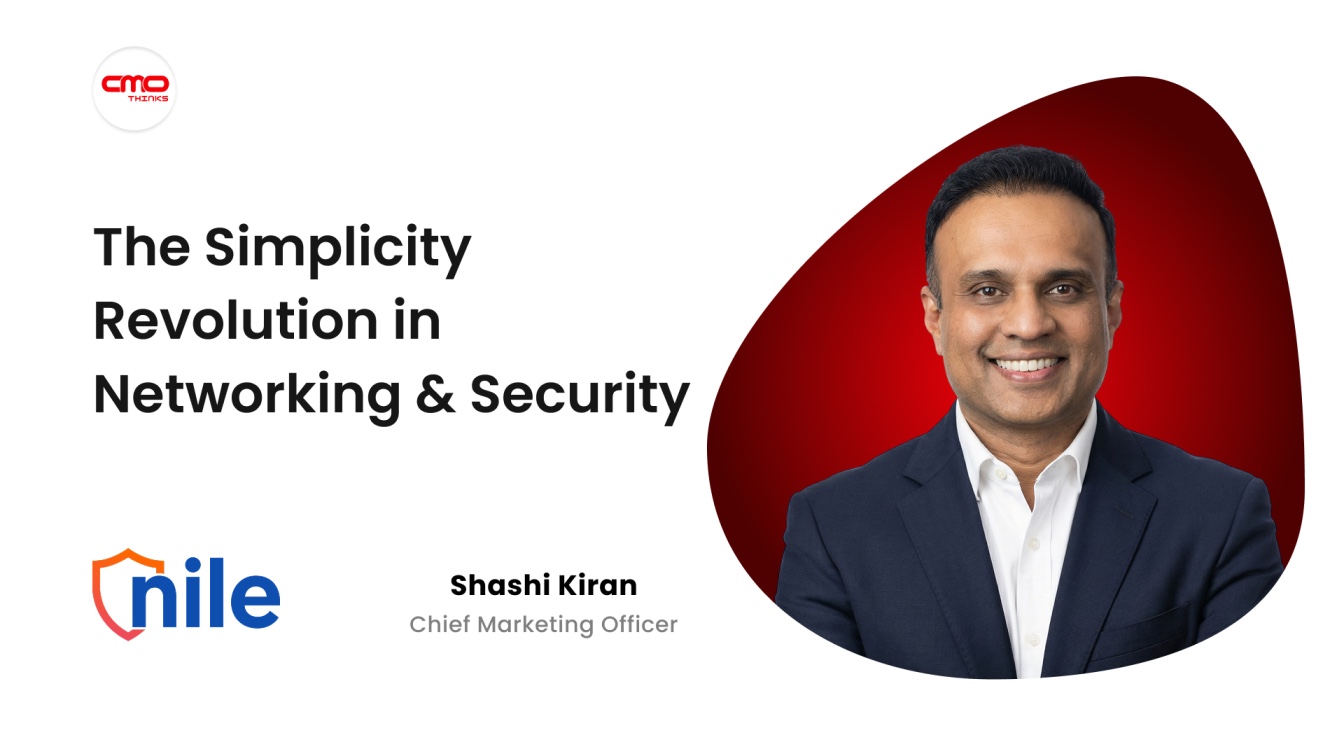
Shashi, you’ve had a front-row seat to the evolution of networking, security, and cloud across companies like Cisco, Broadcom, and Check Point. What key inflection points have most shaped how enterprises think about infrastructure today?
Enterprises need infrastructure to drive outcomes. It could be making their business more agile, more secure, or helping deliver better experiences to their customers at a lower cost structure. For this, infrastructure should be an enabler, and not a bottleneck. Most companies have done a phenomenal job of building infrastructure components that are better, faster, and more secure. However, with the pace of change impacting most enterprises today, managing and operating infrastructure should also be equally innovative. The road ahead is to make operating the infrastructure not only more intelligent, but also autonomous to operate, reducing friction to manage change. They're like cars. You can go from point A to point B while reducing the strain on the human and increasing productivity.
I've been fortunate to work in some great companies in leadership positions, whether it be Cisco, VMware, Broadcom, or Check Point. They've all been instrumental in leading multiple industry inflection points over the past several decades. But no company can afford to be complacent and rest on past laurels. Disruption is usually one wrong decision or one missed inflection point. AI has re-energized everyone and become the new starting point for many. It's an exciting time to be in the industry.
What motivated your decision to take on the CMO role at Nile: the category shift, the problem space, or where the industry is headed next?
Nile was born to alleviate some of the problems that have plagued the industry for the past couple of decades. The center of gravity for infrastructure innovation has been in the data center and the cloud, while the on-premises local environments have largely been left behind. This is where we have the highest density of humans, devices, and things. However, point products and the inordinate operational complexity of managing and operating them increase the cost structure, cause security breaches, and hamper IT productivity. User experience is also heavily compromised. I look at this as having the largest surface area of an enterprise. Nile sensed an opportunity to change the paradigm here. It was founded by people whom I had worked with in the past, and for whom I have deep respect. So, when I received a call to help them on the mission, I felt compelled to join. The broader industry will take time to move there, as it's an architectural shift for most vendors. Not easy to make that shift. Nile adopted a clean-slate approach, which makes the transition simpler and, more importantly, delivers wired and wireless infrastructure as an autonomous service.
Organizations today face overlapping pressures: security risks, operational overhead, and rising costs. How do these challenges play out in real enterprise decision-making?
Most enterprises are what we call brownfield environments. They have grown organically over several decades, and the infrastructure deployments are therefore complex. It's non-trivial to rip and replace. Inertia and change management also slow things down, as do existing vendor relationships and the fear of the new. Enterprises to weigh risk vs reward and tend to move when the risks, overheads, and economics outweigh the benefits of the status quo significantly. Ironically, complexity is the root cause of all these issues. Many enterprises are either experiencing or are on the cusp of what I call the "perfect storm", where the legacy infrastructure is proving to be a competitive disadvantage compared to newer companies that are starting off with a clean slate architecture that simply eliminates decades of technical debt. The true innovation is not in adding a new feature or a new box, but rather in delivering simplicity and removing friction from business.
Nile speaks about a “clean-slate” approach to networking. At a fundamental level, what needs to change in how enterprises approach architecture to move beyond legacy constraints?
It's an interesting question. I believe a lot of it has to do with the mindset. For example, with security, the industry has been conditioned to the fact that if you want security, you need more security products, more security features, more tools to manage them, etc. But adding more links to the chain makes the chain weaker, not stronger. A lot of these point products are appendages of the legacy architecture. A clean slate approach begins with the mindset of removing the unnecessary, whether it be VLANs or multiple point products, and driving foundational concepts like zero trust and identity-centric frameworks, which are focused on prevention rather than cure. This not only eliminates complexity but shrinks the attack surface, risk, and cost structure as well. It creates a win-win for all. Otherwise, plugging a 20-year-old roof one leak at a time will only take you so far.
In a deeply technical space like networking, marketing often leans feature-heavy. How do you ensure the narrative stays anchored in business outcomes and real customer value?
Cloud changed the economics of servers and storage and made it easy to consume them as a service. The outcome being measured was quick access to compute capacity without the hindrances of procurement, management, hosting, etc., allowing teams to scale productivity. However, networking has lagged. The thrust behind secure and autonomous networks delivered as-a-service, fueled by AI, is bringing similar benefits to and through networking at the edge. Let's face it. Most companies, including large enterprises, are asking their IT to do more with less. Nobody's getting additional headcount. So, we see burnout and errors due to fatigue.
How can you propel networking to the modern age, while minimizing downtime, reducing truck rolls, reducing trouble tickets, eliminating breaches, lowering risk, cutting costs, amplifying IT productivity? These are the questions businesses should be asking. These are the areas Nile's focused relentlessly on.
You emphasize trust, authenticity, and meritocracy as core to how you operate. How do these principles shape marketing in an era of AI and hyper-personalization?
In the era of AI, these are the most human qualities you may cherish in the workplace. Just as with technology, teams can be compromised by people who are incompetent, lazy, or unreliable. It penalizes the rest of the team that is working hard, being responsive, or trying to make a difference. Today, nobody wants to manage someone else. A sense of ownership is required, no matter how big or small the role is, or whatever someone's title may be. If these don't exist, their roles will default to being the lowest common denominator, and such roles will be the first to be disrupted by AI, which is impacting every function. On the other hand, those already exhibiting the positive traits, or at least making an honest effort, even using AI, will find their roles to be vastly amplified. We're entering into a symbiotic era with AI, where a person's positive or negative traits will be equally amplified. I'm already seeing the difference.
As a multi-time CMO, how has your own approach to marketing leadership evolved? What do you do differently today than earlier in your career?
Marketing is a multi-functional discipline, perhaps one of the most varied functions within any organization. It is a tough function to hire good people. I like to hire generalists who can adapt, rather than super specialists. Connecting the different dots is an important trait in marketing. I find it useful to constantly grade myself and the team using a skills/wills matrix, which is a simple way of evaluating the team performance when applied to the priorities and trajectory of the company. If a person has skill but lacks will, it's worthwhile motivating them. If they have will, but lack skill, it's worthwhile trying to teach them. If they have both skill and will, I groom them for higher responsibilities, including as my potential replacement. If they lack both, their runway is quite short. A good marketeer has to transcend the marketing function and be a proxy for the market, which means having a pulse of all the functions within the company as well as the market landscape, to calibrate the path for a company's success. The ones that can successfully adapt are usually the ones destined to succeed.