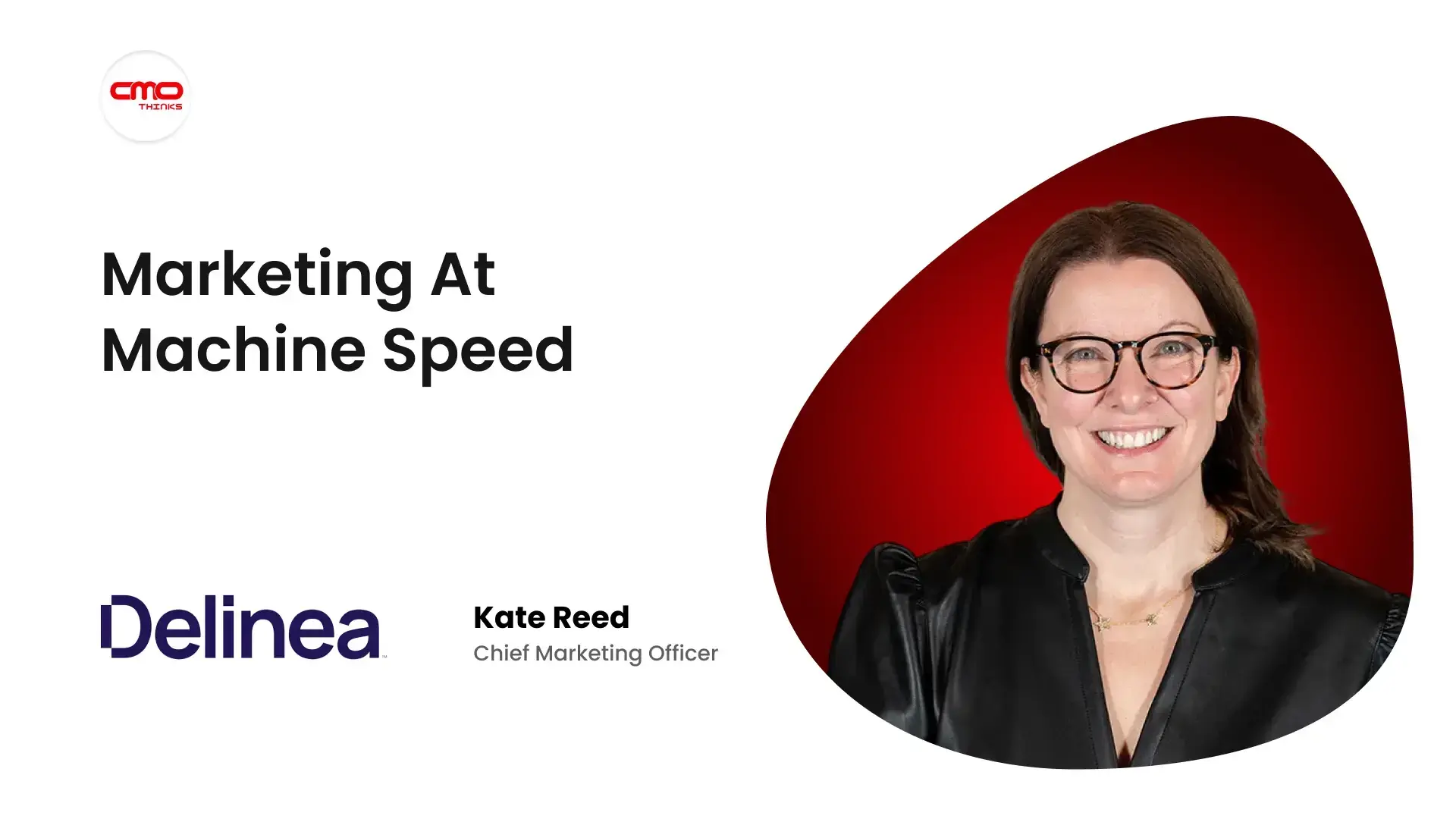
You have led marketing at IBM, Syniti, Devo, and now Delinea. What leadership principles have consistently helped you build marketing systems that deliver sustainable business growth?
Hands down, it's the team. That sounds cliché, but it's the single highest-leverage thing a leader can do: hire smart, curious people who either already know their craft or are hungry to learn it, and who can actually take coaching and collaborate across the business. I've built teams across four very different companies now, and the constant isn't the market or the motion, it's the caliber of the people. You can teach someone a new platform or a new positioning framework. You can't teach curiosity, and you can't easily teach someone to want feedback instead of flinching from it. So I screen hard for both. Give me someone coachable and curious over someone with the perfect resume, every time.
You often describe marketing as a growth multiplier rather than a support function. What organizational changes are necessary for marketing to earn that position within today's enterprise?
Marketing has to own the revenue number with sales. Not a lead goal, not an MQL target, the actual revenue and pipeline number. Too many marketing teams celebrate beating a lead goal. None of that matters if those leads aren't converting into pipeline and revenue.
To earn multiplier status, a few structural things have to change:
- Shared targets, shared comp. If marketing owns leads and sales owns revenue, you've built two teams optimizing for different outcomes. Put marketing on the hook for pipeline and revenue contribution, not just volume.
- Kill the vanity metrics. Impressions, leads, and MQLs are all fine as diagnostics, but useless as scorecards. Report the metrics the CRO and CFO actually care about.
When marketing is willing to be measured the way sales is measured, it earns the right to sit at that table.
Identity security has expanded beyond human identities to include machine and AI identities. From a marketing perspective, how are these shifts changing customer conversations?
a. This is the single biggest shift in our market right now, and it's changing who we're even talking to. The urgency around AI has opened up entirely new buyers and new budget that used to live outside security altogether.
b. The numbers make the case better than any pitch deck could, some of the latest identity security research puts the ratio of machine identities (including AI agents) to human identities as high as 109-to-1, up sharply from the year before, with AI agent identities alone projected to grow another 85% over the next year. That problem extends beyond security teams to platform, DevOps, and AI/ML teams. Suddenly we're in budget conversations with buyers who weren't traditional security stakeholders twelve months ago.
c. From a marketing lens, that means:
i. Speed matters more than polish. How quickly can we adapt narrative and content to a conversation that's moving month to month, not year to year?
ii. New personas, new language. We can't market machine and agent identity the same way we marketed human privilege access management (PAM). Different buyer, different vocabulary, different proof points.
iii. Urgency is now a legitimate, evidence-backed message rather than manufactured FOMO. The security breach data and identity-sprawl numbers do the persuading for us.
As CMO of Delinea, what are your key strategic priorities to fuel the company’s innovation journey and long-term growth?
a. Building AI into marketing itself is a huge priority for us right now. And I mean that more broadly than the obvious answer of content creation. The real opportunity is leading with an AI-first mindset across how the function operates: AI in campaign execution, AI in lead follow-up and routing, AI in how we personalize at scale.
b. The hard part, and the thing I spend a lot of time on, is balancing that against AI slop. It's easy to generate more content faster. It's much harder to generate more content that's actually differentiated and worth a buyer's attention. So, the priority is figuring out where AI removes friction and speed for the team (execution, ops, follow-up) versus where it still needs a sharp human point of view (narrative, brand voice, anything customer-facing that has to earn trust).
c. Beyond that, my other priorities right now are sharpening our AI-forward repositioning so the market understands where we're headed, not just where we've been, and making sure discoverability keeps pace with how buyers actually research now, which is increasingly through AI search tools, in addition to traditional search.
Having worked across some of the world's leading tech firms, what trends do you believe will have the greatest impact on marketing and cybersecurity in the coming years?
a. AI search changes how buyers find vendors before they ever talk to sales. Buyers are increasingly asking ChatGPT, Perplexity, and Copilot to shortlist vendors, not just Googling. That means earning citations and being structurally discoverable to AI matters as much as classic SEO did a decade ago. Most B2B marketing orgs aren't built for that yet.
b. Content volume is exploding while trust in content is collapsing. As AI makes it cheap to produce content, the market gets flooded with sameness. Authentic point-of-view and real proof points become the actual differentiator.
You have stressed the importance of building purpose-driven, high performing teams. What qualities do you prioritize when shaping future marketing leaders, particularly in today's AI-heavy business environment?
a. It all comes down to curiosity. I learned that lesson early at IBM. Marketing is constantly changing, and the tech underneath it is changing even faster. If you're showing up with the same playbook you ran last quarter, you're already behind.
b. So I look for people who are actively learning outside of work: the podcast listeners, the readers, the ones who show up to a call having already gone and networked with someone doing something new. That habit of pulling in outside signal is what lets someone spot a shift before it becomes obvious to everyone else.